Teaspoon
Should we keep doing Christianity? Two thousand years, five or more major branches and hundreds of competing theologies have built a religion and institution almost unrecognisable to the little community of believers in first-century Palestine. Christianity has been complicit in atrocities and violence, in exploitation and oppression. From conquest and colonisation world over, to the exclusion of women and queer people, to the abuse of vulnerable people, harm and cruelty have become attached to the Church and the faith. What is it we’re left with? Do we keep doing Christianity, or give it up?
It might be tempting to discard Christianity, weighed down by thousands of years of violence and shame, and increasingly people are leaving religion behind. That’s has never quite seemed the right solution to me. Many people, traumatised or alienated by the Church, feel no compulsion to go near the place, and it’s not my place to tell them how they should feel. But to say that our salvation is to abandon religion seems too convenient, too neat and comfortable. It implies that the cause of the harm, the abuse, lies somewhere in faith and religion, that there is a rot in places like the New Testament which leads to cruelty and abuse. But when I look at history and at our world, that doesn’t ring true. Governments and institutions are entirely able to marginalise people, without adhering to the tenets of Jesus of Nazareth, or the Councils of Nicaea and Constantinople, at least regarding Christianity. Being nonreligious hasn’t prevented generals from genocides, tech oligarchs from ripping away rights, CEOs from destroying the future. So it isn’t simply an instinct towards violence within Christianity, that abandoning it will solve everything. It feels like a scapegoat.

Source: Unsplash
My unease is compounded hearing it from Western opponents of the church. If all the abuse and evil of the West is tied to Christianity then a non-Christian Westerner doesn’t need to change. The abuse, violence, and horrors no longer touch us: we can say we’ve washed our hands of the affair. But have we? In the 21st century, the average Christian lives in South America or Africa, and is most certainly not white. The mission to globally leave behind religion is, at this point, a group of wealthy, Western, generally white people going to the places we have exploited and continue to exploit, telling them the solution to their problems is to abandon their religions and become like us. Without even trying, we reenact the colonial dominance we abhor the Church for being involved in. The rot isn’t in Christianity, it’s in us: we in the West have not recognised or reckoned with our power, our privilege, our desire to control the world around us. Christianity has been complicit in evils, but is the root of that evil within the Church, or does it lie somewhere else? Because if it’s not, then there’s no reason to believe leaving Christianity cures the disease.
So I can’t bring myself to believe that the solution to our broken, fractured, religion is to just drop it and move on, hoping that whatever caused the problems gets left behind too. Christianity didn’t make the West vile, the West distorted Christianity to its own ends. Maybe the truth is that power distorted it, because it is hardly only in the West that Christians have badly mangled Jesus’ teachings. But we’re still left with the question: what do we do with Christianity? Do we just keep on as it is, accepting all the horrors of the Church as just the inevitable results of inner evil, decide everyone should just put up with it? I think that’s often been the ultimate answer of the Church and its leadership. It’s a terrible answer, no more useful or honest than trying to pin all human ill on the Gospel. There’s more we can do than nothing, and more options than business as usual and giving up entirely. What we need, is a salvage operation, to salvage the Gospel back out of the Church.
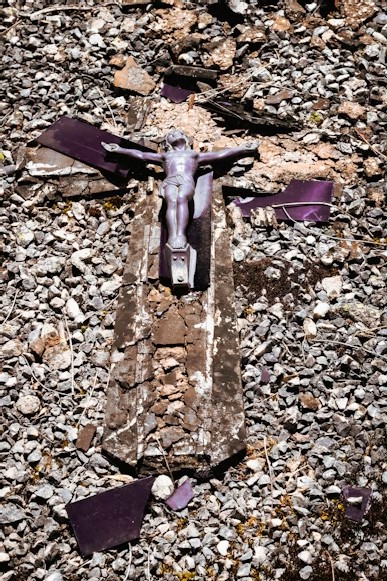
If a house has flooded, with stained walls and rotten floors, it is a good start to collect what still works before you clean the place up. So, what can we keep? Christianity has meant many things across millennia and continents, with different principles and interpretations rising and falling around the key theological tenets. The best thing to do would be to comb over the sodden rooms to find the pieces which survived: what can we find and collect as we try to salvage this old, worn religion?
Source: Unsplash
No salvage of Christianity can be done without salvaging Jesus himself. What do we keep? Firstly, he was a Palestinian. That’s inarguable, since he was born in the land of Palestine. He lived under foreign occupation by a European empire, which imposed heavy burdens on his loved ones and his people. He was working-class, a carpenter’s son who had a mother to care for and several younger siblings. He had a deep understanding of God but rarely seemed to enjoy the company of religious authorities, preferring to spend time with those everyone else decided were unclean. He taught people and built a devoted following, primarily from among the outcasts, people who were often outright discarded from intellectual and political life. He spent his time in the countryside and the regions, away from the centre of power. Ultimately, he was arrested by the authorities and turned over to either a willing (or enthusiastic) occupation, and was tortured and executed, lynched by the powers that be. Many had hoped the messiah would come and deliver the people from the Romans, but Jesus was killed by them.
Now for Christians the story doesn’t end there: for Christians, Jesus is resurrected, defeating death and liberating us from sin. So who is this Jesus? What would he say of our world? What would he look like, and who would he align himself with? If Christianity is to be salvaged from the contortions of Power and Empire, we need to keep in mind exactly who Jesus was, and who he is. Just because Jesus didn’t pick up a sword and lead an army doesn’t mean he didn’t think the Empire was evil, something to be opposed and dismantled. It means he understood violence eats at the soul. It might sometimes be necessary for us on earth, but it is never good, and it was hardly the example Jesus wanted to leave us. What Jesus did was build people up, create community and support and affirm God’s love for all, a love he would go on to die for. So when Christian Nationalism speaks, we should see through its lies and distortions. Jesus Christ wouldn’t align himself with empire, but against it. He wouldn’t embrace violence, hatred, or vengeance. His message was revolution of our souls and the transformation into better people, not to affirm the right of the mighty to crush the marginalised. The only group Jesus ever attacked were merchants, turning faith and religion into a business and marketplace. He declared one cannot serve God and money.
Source: Unsplash
Now let’s look at something too many Christians insist on: guilt, fear, and shame. Across the history of Christianity, guilt and shame have loomed like a spectre. It’s not hard to understand why: these feelings can be effective in getting people to show up and sit down, and many Christian leaders have taken a larger congregation to be the sign of successful evangelism. But is it really all that helpful? So much can (and sometime, should), be said about sin, but to briefly check in on the New Testament;
“God is love. Whoever lives in love lives in God, and God in him…There is no fear in love. But perfect love drives out all fear, because fear has to do with punishment. The one who fears is not made perfect in love” (1 John 4: 16b – 18).
So whatever Christian faith should generate in us, it’s certainly not fear. Now I’m not removing the concept of sin completely, just affirming that the point of confession and sin is not to burden people, but the very opposite: in confessing and acknowledging, one is forgiven and may step out into life again unburdened by her sins. Maybe there’s a moment of guilt in the recognition, but no more heavy than the brief twang of guilt we feel admitting to hurting or disappointing a friend. We should also remember that there’s no expectation to ever truly be rid of sin in this life: only Christ is without sin, so there’s no expectation that someone will never sin again after confession (except maybe our last one). Christianity is a “race” (Hebrews 12:1-2) because it is a striving, a perseverance to be who we want to be in life. We’re always trying, failing, getting up, and continuing, a transformation that’s never quite finished, but is always progressing. There’s no need for guilt or shame, because our missteps and mistakes don’t own us. So we can leave behind any notion that we need to be ashamed, full of guilt before God, but salvage the truth that while we do miss the mark and sin, that’s okay. We can and will try again, because we trust that we are forgiven. We want liberation, not bondage.
So Christians don’t need to be burdened by guilt: nice for them, but should they be making everyone else feel so ashamed? Making people feel awful can convince them they need your help, but it’s hardly an acceptable way to treat one another. Jesus said someone shouldn’t try to take the spec out of someone else’s eye while they had a tree branch in their own (Matthew 7:3-5), so I can only imagine what he’d think of a Church rife with abuse and scandal, with blood-stained hands, telling other people to get their lives in order. Christianity’s recruitment system shouldn’t involve bludgeoning everyone over the head, especially when the Church has such a sordid life of its own. So how should Christians recruit? Honestly, the question reveals just how bleak the modern Church has become. Christians are meant to be full of life, of joy, people free from the chains of guilt and who know God personally. If we wanted to encourage others to join the club, maybe we can lead with that, rather than screaming at them for being unclean or evil. Jesus’ call was to the burdened, to come and receive rest (Matthew 11:28), and that’s a far better offer than the one of the Church right now: “come to us, you wretched filth, so we can tell you how you should be living.”
This salvage operation is a big one, too long for one blog post. I’ll finish for now by giving us a chance to reflect: what have we got so far? What’s our basic, refreshed Christianity for the modern moment? It’s one which saves us from fear, and which entices rather than terrifies. It’s aligned with who Jesus was, and speaks love, not shame. You can phrase that Gospel how you’d like, but here’s my attempt:
The world is broken place, and all of us are carrying guilt, pain, and hurt. None of us are perfect, least of all me. But I know this: that the world doesn’t have to be this way. We don’t need to be worn down or burdened. God is out there and wants things to be different. We should be cut loose from all that binds us and be able to find rest. We don’t have to bear things alone. The work of healing and restoring is underway, and Jesus tasked those who follow him with pursuing Justice, Joy, Mercy, and Compassion. Fixing things is a long, hard task, but we can do it. I’d be beside you every step of the way. You are special, and you are loved.

Source: Teaspoon

 The Teaspoon Brigade