Teaspoon
Is it just me, or does Christianity seem to be falling apart? In some countries, there’s a surging “Christian Nationalism” linked to neo-conservatism, and Christian figures being turned into heroes of fascistic movements. The Anglican church appears to be formally splintering based on whether a woman can be the archbishop of Canterbury. But there’s also churches pushing for social progressivism, supporting marginalised people both locally and internationally, rejecting cruelty. The modern ‘Church’ includes the Pope decrying famine and slaughter in Gaza and American preachers calling for ethnic cleansing. What even is Christianity now? There’s a friction, a rending apart over where the church will go next. How did we get here? What happened to the followers of a Teacher in Roman Palestine? Does Christianity need to be this way?
Being fair, there’s no one Christianity, and there hasn’t been for over sixteen hundred years. Depending on who you ask, there is anywhere from two to six main branches of the faith, which emerged from the same source but have diverged significantly from one another – personally, I’d say there’s six distinct branches of the Christian tree, five of which have ongoing presence and impact today. This said, my questions look mostly at the church in places like the US, UK, and elsewhere in the ‘West’, and I don’t think it’s because of the mixing of these five distinct branches of the faith; it’s not the case that there is one conservative church is conservative, while another advocates for justice. No, this is something else.
I think it started with Rome, with the Empire. Christianity has a long, long history with empire and imperial power in the West. There’s several branches of Christianity, but there are three which can be described as Roman churches. For almost three centuries, Christians were marginalised and even persecuted for their beliefs; almost all the major Christian thinkers and writers of the period were tortured and killed for their faith. But the faith still grew, and it found its way into the halls of power: in the early fourth century, realms began to convert and adopt Christianity as their official religion: the Kingdoms Armenia, Georgia (known then as Iberia), Aksum (today in Ethiopia), and then, the Roman Empire.
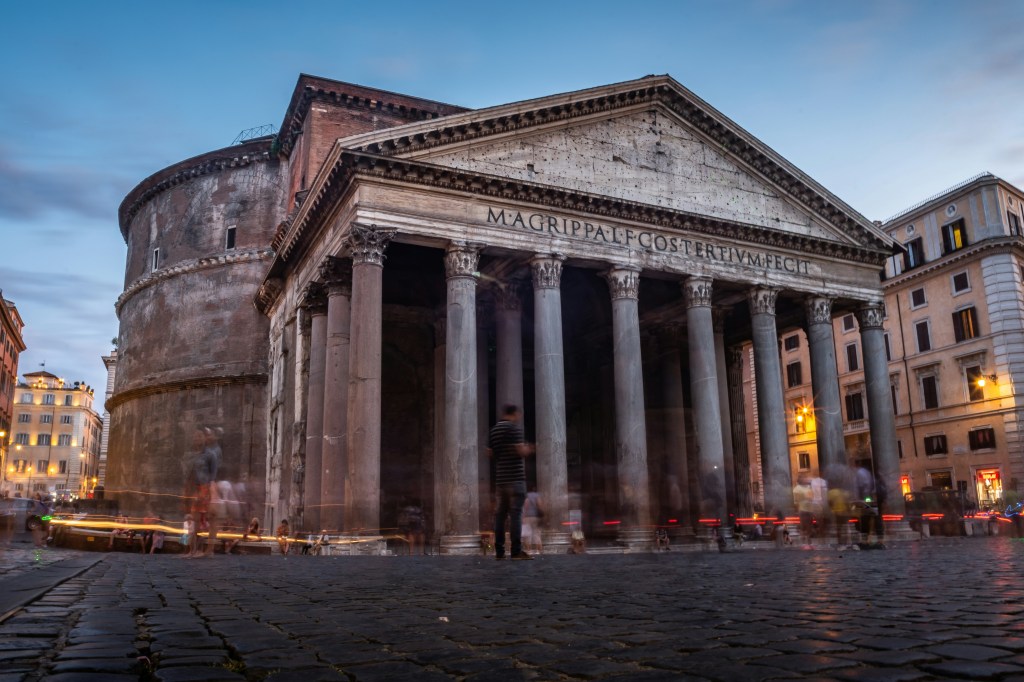
The Pantheon in Rome, once a Pagan Temple which was converted into a Christian Cathedral. Source: Daniel Klaffke, Unsplash.
Something strange happened when Christianity became the faith of Rome. The New Testament was written by people with little love for Rome, ,who thought the end of the world was near and that the empire was fundamentally unjust. It was at best something to tolerate, but while it could claim one’s coin, it should never possess one’s loyalty. This empire openly professed Christianity as truth. Rome was one of the largest realms of its time, a true empire based on subjugation and slavery, in which most held few rights, and a few held many. The five (or six) branches of Christianity formed first and foremost because of theological disputes, but the reason the Catholics, Protestants, and Eastern Orthodox are all Roman is because they emerged from the Roman church. The Oriental Orthodox, and the Church of the East, these Christians were never under Roman control – this might be why for some today, they don’t count as proper Christians at all.
Once Christianity was the state religion of an empire, the politics of empire began to steadily work their way into Christian thought. A Roman emperor demanded the first great church council, to resolve a theological crisis he personally found embarrassing and irritating. The leaders of the rival Sassanid empire, centred on modern Iran and central Asia, saw Christians in their territories as potential spies, or a point of tension for the Christian Romans – ultimately, the imperial rivalry further inflamed a different theological dispute on Jesus’ nature, one which led to most non-Roman Christians denounced as heretics in the fifth century. Today, many Christian thinkers agree the dispute was more about language and translation than actual different belief.
The Roman church began to see itself as the Church, the only place where the pure teachings and theology of Christ was preserved. At the same time, the Roman empire underwent seismic change. The protracted and messy ‘Fall’ of the Roman empire demonstrated something to the church: its status, security, and privileges as a state religion were not guaranteed: they could be lost. In the Eastern Roman Empire, also known as the Byzantine Empire, known at the time as the Roman empire (I am sorry), the church became closely linked with the state and the prerogatives of the emperors. In the West, the bishops of Rome eventually came to wield material political power as well as spiritual authority, becoming feudal lords of their own realm, the Papal States. There came a break between ‘East’ and ‘West’, forming the Orthodox and Catholic churches. Then later, amidst crisis and scandal the Catholic church splintered apart as protestant movements emerged. By the time the dust settled in Europe, there were Lutherans, Anglicans, Calvinists, and more in the newest, youngest Christian branch.
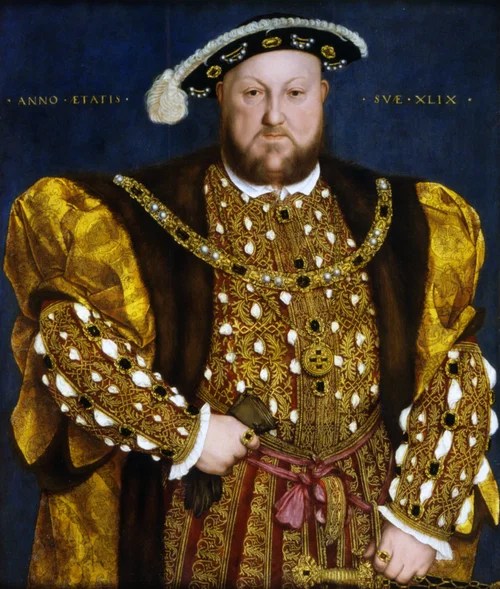
Henry VIII of England, who broke with the Catholic Church and became formal head of the English Church. Source: Mark Cartwright, World History Encyclopaedia, https://www.worldhistory.org/Henry_VIII_of_England/.
By now, European kings were building new empires across the ocean and in marriages: The Spanish, Portuguese, English, French, Dutch, and Russians all built substantial realms within or beyond Europe, with latecomers including Denmark, Sweden, Belgium, and Austria. Some of these empires were Catholic, paying heed to the Popes in Rome; others simply took heed of respected protestant theologians, and in the case of the English, the monarch was the head of the church. the English, (or British, as they called themselves after the union with Scotland) became the preeminent empire, by some measures the largest empire history has seen. Christianity had moved from an underground sect, mostly popular with slaves, women and the poor, to being the formal faith of the world’s largest empire, whose church was headed by a King.
And yet, the message of the Gospel was unchanged. Being themselves believers, Christians struggled to actually change the words of Christ, and though they adjusted what parts of the Gospel were given emphasis or loosely interpreted passages in favourable ways, the alternate readings were always there. The radical and revolutionary Christianity, opposed to empire and political authority, which resisted power and hierarchy and cared more about doing good, was never removed. So the same scriptures which drove empire also drove its opponents and resistance. The church as institution became heavily implicated in the work and crimes of empire, and these failings continue to plague it to today; but the church as community remained, not just outside churches but within them. Although the Churches have much still to answer for, they somehow have been an ally to opposition to injustice, and the lessons of the New Testament still give inspiration on community, on compassion, and on justice.
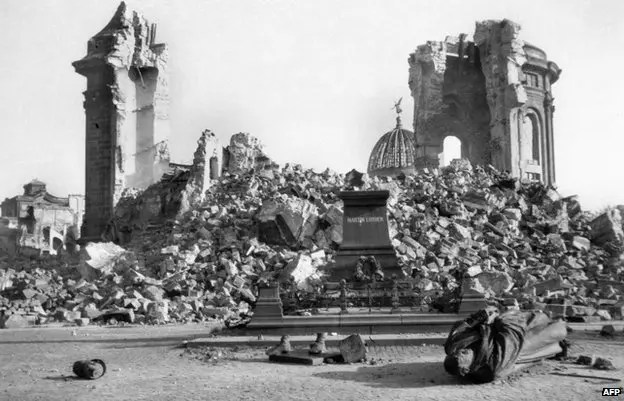
Dresden’s Frauenkirche with the Martin Luther Memorial in the foreground, rendered unrecognisable after a bombing raid during World War Two. Source: Jenny Hill, BBC News, https://www.bbc.com/news/world-europe-31448992.
What we are seeing now is the of millennia of baggage on Christianity, its association with empire, its complicity in atrocity and power. The eventual end-point of that journey, the slow walking alongside empire, is that the boundary between the two disappears. There comes a point where churches, so used to deferring to the view of power against possible threats, becomes nothing more than a mouthpiece, no matter how revolting the words of become. Some German Christians, so consumed by fear of communism and hate for Jews, willingly joined the Nazi-sponsored churches, even though these defied Christian teachings and renounced parts of the Gospel. Christians, and Churches, are afraid: afraid of being persecuted, afraid of losing their congregations, afraid of losing the protection of the powerful and becoming their enemies. It is fear, and maybe greed from some leaders, that drives these Christians.
Growing up, I used to hear a binary distinction between love and hate. I think a better distinction would be Love and Fear, because hatred is a secondary emotion. One cannot Fear what one Loves, or Love what one Fears. The two currents of Christianity are defined by these two emotions. One group is afraid of persecution, of the loss of privilege, of a changing world, of what it means to reckon with millennia of wrongdoing. The other group is focused on love; not just love of God, but of people. The underlying message of the Gospel is, if you’ve not read it, one of love. This includes God’s love for humans of course, but also human’s love for one another. The crossing of boundaries, the rejection of prejudices, recognising shared connection and celebrating it. Which of the two will succeed? I cannot speak into whether the Christians driven by fear, or those moved by love, will be successful in defining “Christianity” and the direction of the church in my own lifetime. But which one will hold onto the meaning and truth of the Gospel? That I can answer.
“God is love. Whoever lives in love lives in God, and God in them… There is no fear in love. But perfect love drives out fear, because fear has to do with punishment. The one who fears is not made perfect in love. We love because he first loved us.” (1 John 4:16, 18-19).
 The Teaspoon Brigade