Teaspoon
While I generally dislike grand narratives of history, there has been one ongoing feature of the past 500 years which has, at least in some ways, defined the period: the ongoing project of Empire. History is messy, incoherent, and contradictory, and the more I’ve learned the harder it’s become to discern where eras begin or end, let alone what defines them. But despite that, I think we need to sit and reflect on this project of Empire, the growth of world-spanning powers and the myths those powers spread. Not just to understand the world we live in, but because this Imperial project could be coming to and end, and in its place, we can build something better.
Empires aren’t new: history is littered with them. A basic definition of empire might call it some collection of states or entities with one ruler, at their core empires are those entities which have both citizens with full rights and privileges, and subjects, without them. For much of history there was a natural limit to empire; political decay, limited bureaucracy, and sheer geography constrained Imperial power. Not anymore. The interests and schemes of Empires have for centuries now defined the lives of all of us, across the globe. Imperial domination has reached previously unknown heights. What began in Spain in the late fifteenth century has reached its boiling point. So what happened, to put us on this course? How did this Grand Imperial Project begin? It started in the conquests sponsored by Spain.
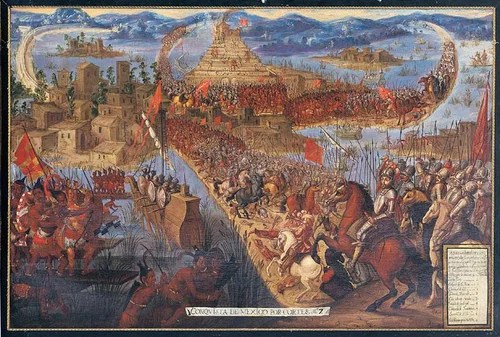
The Siege of Tenochtitlan, Capital of the Aztec Empire. Source: World History Encyclopedia,
https://www.worldhistory.org/article/916/cortes–the-fall-of-the-aztec-empire/.
When the Spanish arrived in the Caribbean, they brought whole populations of people under their dominion. Through a series of military campaigns, outbreaks and deliberate introductions of disease, and systematic dispossession, the Spanish brought most of what we now call Central and South America under their rule with shocking speed. The Spanish had a fervent desire to strengthen a Church drowning in scandal and realised how much money could be made from conquest. The other European powers, many of them starved of wealth and exhausted from war, took notice. They had gunpowder, steel, and horses; the peoples across the sea did not. In 1521, the Spanish and their local allies conquered Tenochtitlan, capital of the Aztec empire, and began to bring the region under their control. Twelve years later, they had not only broadened their rule through New Spain, but had conquered the Inca in the South, though resistance continued for many years.
Here begins the Imperial Project, which is both the ongoing efforts of global powers to dominate as much of the world as possible, and the formation of a narrative in which all human history is understood as a battle between empires (or ‘civilisations’) in a fight for supremacy. Since the Spanish, others have filled the role of the leading empire. The British, French, Dutch, and others began empire building efforts of their own, and the British emerged as Preeminent by the 1800s, triumphing over the French. The European empires, exhausted after the World Wars, gave way to the USA and the USSR as leading imperial states. In our own time, after 500 years of empire, it is the Americans who stand at the top – lesser imperial powers might include China and Russia, or old powers like France and Britain. All these have carried the banner of ‘civilisation,’ claiming to bring progress and freedom. All enacted violence on dissenters and asserted the belief that some people deserve to rule, and others to be ruled. All empires trade in inequality, and all insist otherwise until their masks are stripped away.
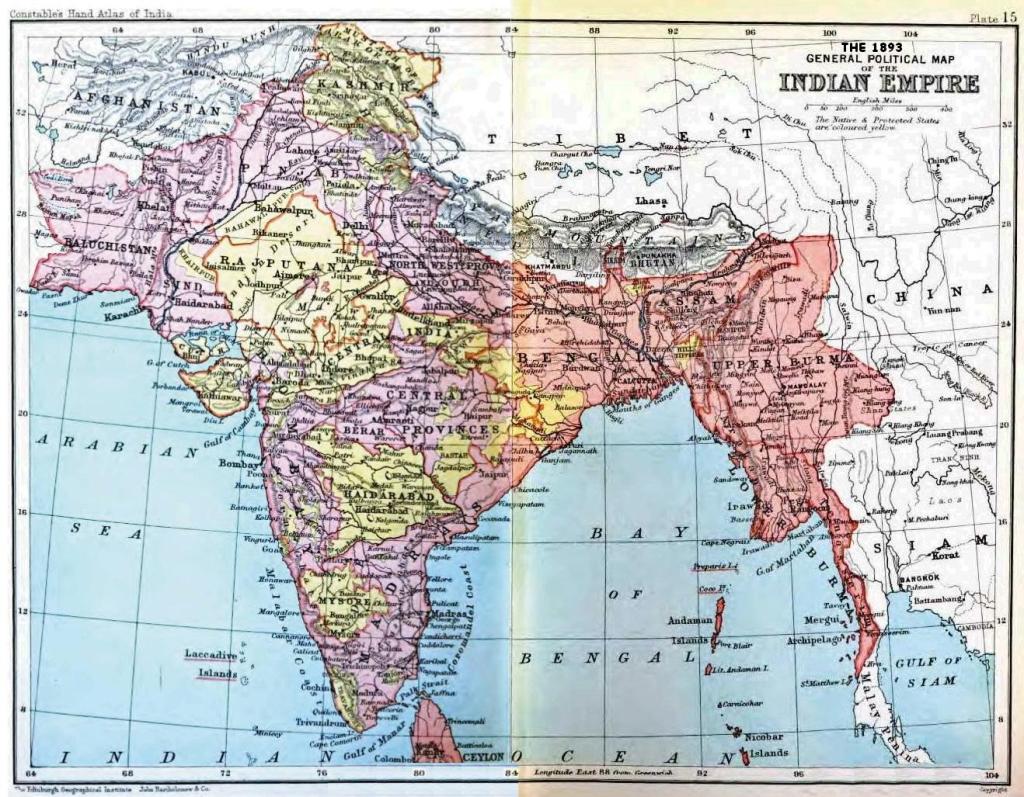
British-controlled India. Source: Prabhat & Usa Patnaik, https://monthlyreview.org/articles/the-drain-of-wealth/.
You might recoil at the thought of the Americans or the British as imperial powers, but remember: the USA is quite literally built atop nations whose sovereignty and land is not recognised, and the enslavement of millions. And there’s also the matter of the five US territories who are not permitted full rights – over three and a half million people, more than the population of Utah, Nevada, Hawaii, Mississippi, or Iowa. And this is still not considering the people whose rights and sovereignty the USA has trampled on, such as in Chile and Guatemala, or those attacked and occupied by Americans to keep America safe, such as Iraq and Afghanistan. Don’t let language slip you by; it’s not the Iraqis or Afghans who are made safe by these interventions, and it was never supposed to be – it is to keep the citizens of Empire safe, that other nations are occupied and bombed. This is the logic, and the foundations, of Imperial power. The British extracted massive wealth from India for themselves – the Indians were governed by the Empire, but in return it impoverished them over centuries. For five hundred years, as different realms and states jockeyed for power, this language and logic of empire has embedded itself in all of us. Perhaps it is in you. It whispers that this is normal and natural, that exploitation is just what politics is. That is the voice of empire justifying itself.
All empires fall. This is as true as anything else about them. They are unnatural things, binding people against their will and always moving away from justice, peace, and kindness, virtues we recognise as fundamentally human. Every empire believes it has defied the odds, will live forever. They never do. As the new millennia dawned, one empire ruled supreme in the USA, giving us a unipolar world. Not thirty years later it’s all coming apart. With the encroachment of Climate Change, the Imperial Project itself could come undone with American Empire. The time of colossal, continent-wide powers might disappear into the past. Don’t mourn this: it is good when any empire falls, because empires are unjust things. People should not be bound against their will into states that don’t represent or serve them, live their lives and die brutal deaths for someone else’s benefit. Maybe it’s not surprising that as empires fall, their adherents take up the banner of fascism, clinging to whatever might keep their power alive. It’s frightening, but it also affirms that the empires are eroding, and they won’t survive forever.
That means that while these past centuries have been shaped and defined by Empire, there’s no reason the next ones should be. Let whatever comes next be the ending of the Imperial Project and let something more equal and just take its place. It is high time a new project began, and this one ended.
 The Teaspoon Brigade