So, Andor has some issues. I wanted it to do better on gender, I really did. But we can’t ignore the problem, because if we do then the depictions and undertones won’t change, and that sucks. All movements towards justice are feminist, because if we don’t care about women then we’re only committed to the liberty of some people, and the world we make in the aftermath of victory won’t liberate everyone. In Part One, I talked about this issue mostly through the character of Bix Caleen, but it rears its head in other places too. The gender trouble in Andor is kinda everywhere.
First though, I think we should appreciate the embedded sexism is in Star Wars, a fandom that has often been dominated by men and boys and which until recently didn’t really think about gender or feminism. Star Wars had a pretty bad gender representation problem, which modern installments are correcting. But that legacy has impacts. First of all, consider those characters from Andor who were already in Star Wars, and who weren’t “new” (not including visual/single scene cameos). For men, you got Cassian Andor, Ruescott Melshi, K2SO, Saw Gerrara, Bail Organa, Director Orson Krennic, Colonel Wulf Yularen, Admiral Raddus, Erskin Samaj, Pao (Cameo), Tubes (Cameo), and a Rebel High Commander (Cameo). That’s nine regulars and three cameos. For women, there’s Mon Mothma, and a Rebel High Commander (Cameo). That’s one, and one cameo.
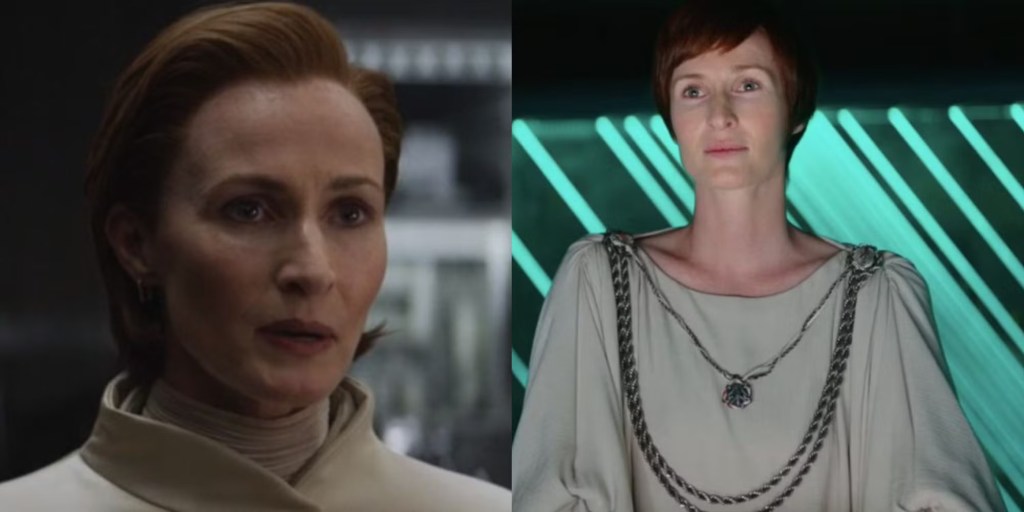
Only one woman from Andor was already a Star Wars regular. That’s a bad start. Source: https://screenrant.com/star-wars-mon-mothma-facts-trivia/.
So I think it’s clear that part of the problem is that Star Wars doesn’t actually feature many women (or at least, official installments didn’t until the Disney era), but Andor corrects that pretty firmly here. For new women characters, there’s Bix Caleen, Maarva Carrasi Andor, Dedra Meero, Kleya Marki, Vel, Cinta, Dreena, Enza Rylanz, Eedy Karn (nine). That said, there’s a lot more men still: Luthen Rael, Brasso, Salmon Pak, Wilmon Pak, Lio Partagaz, Blevin, Heert, Lonni Jung, Sergeant Mosk, Syril Karn, Kino Loy, Carros Rylanz, Davo Sculdun, Perrin, Tay Kolma, Nemik, Skeen, Taramyn, Lieutenant Gorn (nineteen, minimum). That ratio, almost 2:1, isn’t fantastic (keep in mind, it’s 1:1 in real life), but it’s better than the ratio of established characters. I haven’t listed every character, there’s plenty of other Ghormans and prisoners on Narkina Five for instance, but most of them are small players, who don’t really have singular scenes, and whose names are easy to miss or given off-screen. There’s also characters who are never seen but have a presence, like the emperor, or rebel cell leaders like Anton Kreegyr and Maya Pei. If we listed everyone, the gender balance would tip even further, so the ratios I’ve mentioned here are pretty generous.
Andor is trying to address the embedded gender imbalance of Star Wars; many of the new characters (Maarva, Bix, Kleya, Dedra, Vel) are major characters with defined stories and arcs, while many of the men are in supporting roles. Also, a good deal of the gender imbalance comes from imperial institutions which are supposed to be sexist being staffed almost exclusively by men, and by Cassian going to a men-only prison. But we do have an issue for the show. Of all these interesting women characters, only Mon Mothma is active in the movies which are set after this. And so, the fan question of “what happened to __” hangs over the production. Now this isn’t a real problem, the instalments of Star Wars are set in galaxy-wide wars, there’s millions if not billions of places someone could feasibly be off-camera without breaking suspension of disbelief. But either because of that question, or a general desire to trim the cast down, the women in Andor don’t do great. We talked about Bix’s story and arc, or extreme lack thereof, so let’s look at the other women of Andor.
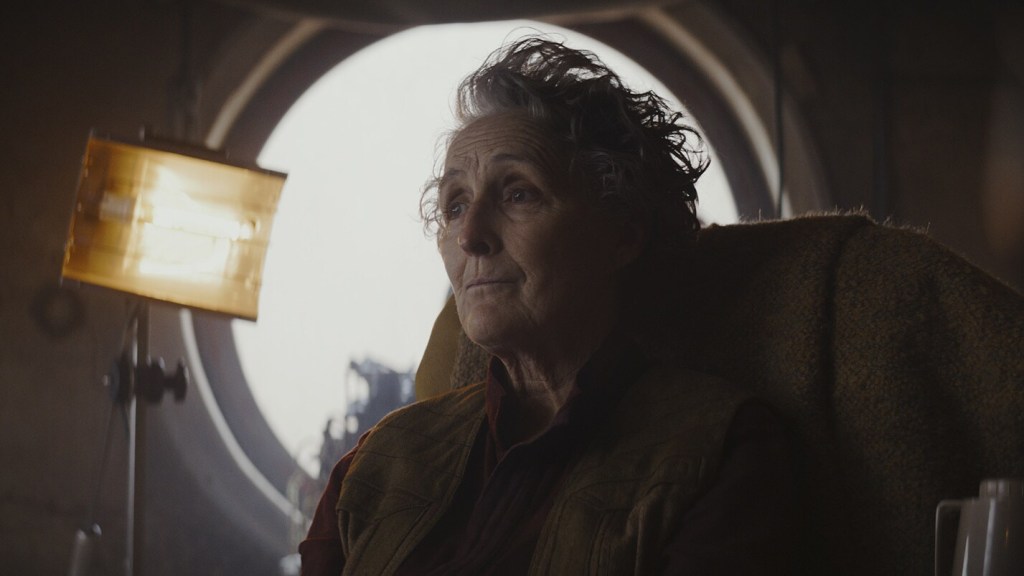
Whatever problems the show might have, I’m happy we got Maarva. Source: https://www.starwars.com/databank/maarva-andor.
Maarva Andor:
Cassian’s mother, she is elderly and stays on Ferrix throughout season one as a primary character. She is inspired by word of the Aldhani raid and determines to help the rebellion any way she can; ultimately, her death and funeral become a lightning rod of rebellion which acts as the climax of the first season. Overall, A+ work, great character. A good starting point for the women in this show.
Dedra Meero:
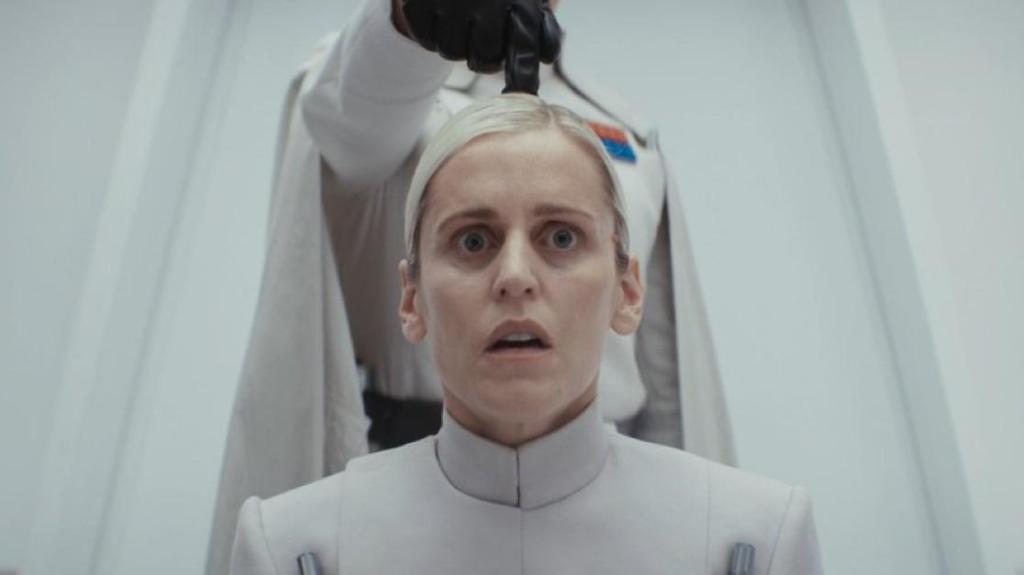
A powerful, fascist girl-boss working among a sea of men, Dedra spends much of the show hunting Rebels, except for the extended arc where she helps organise the Ghorman genocide. Across the show, she is stalked, forms a relationship with her stalker, manipulates said stalker-turned lover, is physically assaulted by him when he learns of this, loses him when he is killed in a massacre she technically greenlit (though he was shot by a rebel), accidentally allows the rebels to learn of the Death Star by being nosy and breaking rules to follow her obsession with “Axis”, which brings down her workplace leading to several colleagues deaths, and is ultimately arrested and stripped of all power, going to a labour/death camp. That is admittedly a harsh recount, Dedra is still presented in many scenes as strong, capable, and clever. She does find rebels, outmanoeuvre colleagues and rivals, and climb the workplace ladder. The trouble with her story is twofold. First, the stalker-to-lover-to-assaulted-bereaved relationship (which is often interesting & well depicted, just also a bit problematic), and second, her colossal downfall, which while satisfying and thematic in a vacuum plays into a bad trend.
Vel & Cinta:
Two rebel warriors, who are in a romantic relationship! Very fun! They are survivors of the Aldhani mission, and we learn that Cinta is something of an assassin for the rebellion, on several occasions ruthlessly removing enemies or threats. Vel is cousin of Mon, which gives her some extra dimension, while we learn Cinta was a victim of imperial violence which led to the death of her family. In season two, Cinta is killed by friendly fire during a mission, devastating Vel. By the next set of episodes, Vel has retired from active rebel life, choosing to onboard and train new rebel recruits instead of going on dangerous missions. She remains in that capacity for the duration of the show. These two are good, but I have to point out they’re some of the only queer characters, and one of them dies in front of the other, which lines up pretty well with the bury-your-gays trope. Not huge complaints otherwise, but for something for later.
Kleya Marki:
Luthen’s Aide (or superior) on Coruscant, coordinating rebel cells and operations. She is ruthless, utterly committed to the cause, and in season one is the force keeping Luthen in line. She pushes to have Andor killed as a loose end, and keeps track of rebel comms in season one. In season two, she continues her work in comms, attends Mon’s wedding, recovers a listening bug, and in the final episodes kills Luthen after he is captured by imperials, before being extracted from Coruscant to pass on Lonni’s intel on the Death Star, setting in motion the events of Rogue One. It’s revealed in flash-backs that Luthen is a father-figure to Kleya, having rescued her from a massacre and working with her from her youth in rebellious activity. Her future is left uncertain at the end of the show.
Others:
Enza and Dreena are Ghorman women involved in season two; Enza is killed during the massacre while Dreena survives and settles with Wilmon. Eedy, Syril’s mother, is a complex and intense parent who seems to make Syril miserable, but is devastated by his death.
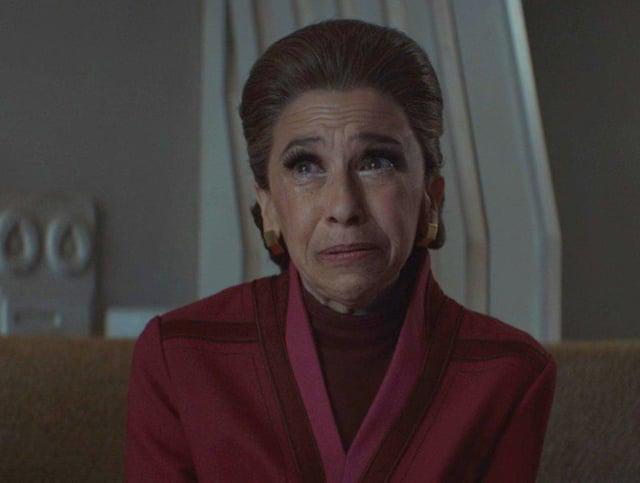
Just saying, maybe we could’ve explored Eedy’s grief and feelings? Otherwise it does feel like her whole narrative point is for her son’s benefit. Source.
There’s a lot to say, but I do want to emphasis: these women suffer, and that suffering is often connected to a man. It’s not just Bix: Eedy’s final moments in the show are grieving over Syril’s death. Indeed, she seems to exist in the show only to frustrate Syril, give him lectures and set up job opportunities for him, and then to grieve his death. Twice a woman is killed in front of her lover on Ghorman, to dramatic effect (Cinta and Enza). Vel sees her lover gunned down by mistake. Enza and Dreena have their planet ruined, during which Enza is killed. Kleya is forced to kill her father figure, who saved her from being massacred (and also, all her loved ones were murdered). This is Andor, and lots of characters go through pain, but for the women it is relentless, especially when combined with takeaway two – that the women who step outside of traditional roles are punished by the narrative, often with death.
Bix, the mechanic and smuggler, is arrested, tortured, assaulted, spends two-three years overcoming all that trauma, then leaves the show – to become a mother living a quiet rural life. Cinta, the warrior and assassin, is accidentally killed in a mission, something so distressing that when we next see Vel, she’s left the fighting behind to become a teacher and trainer. Eedy the mother lives, as does Dreena the Ghorman who mostly acts as the love interest for Wilmon (not to overlook her hauntingly brilliant radio call for help). Enza is killed in the rebellion, in one of the more graphic deaths of the show (she’s one of the few people whose deaths at the hand of a droid is depicted in full, rather than off-screen). Dedra, the woman working in imperial counter-espionage, completely screws everything up and goes to jail. Kleya lives, but is forced to kill her father and ends the show in traumatised, reflective state, being cared for by Vel. The women who survive the show are (by profession) a mother, a second mother, an educator, a love interest (do we ever see Dreena on missions after Ghorman?), a disgraced fascist in prison, and a former spy at a loose end. The dead women die of old age (Maarva), or as soldiers. Beyond literal deaths, Dedra and Bix are more-or-less written out of the war effort, while Vel is working in a support role – the survivors have stepped back.
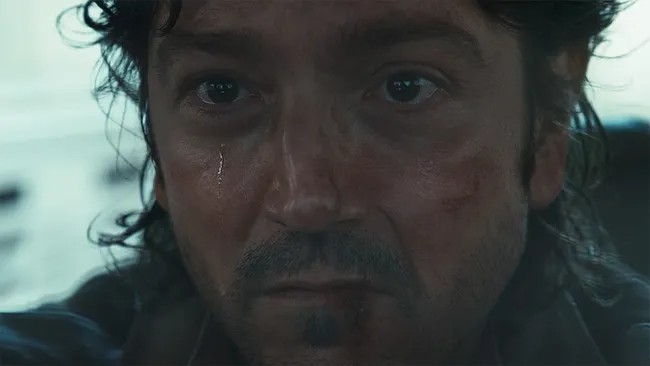
Men do get to cry in this show, but somehow the men push on where the women seems to shrink back. Feels like an undertone of men being stronger or better fighters. Source.
Compare this to the men. The men of Andor are no strangers to pain and trauma, but look at the results: Cassian loses his father, is arrested (twice), sees his childhood friend murdered, witnesses multiple massacres, all because of the empire, and it only strengthens his resolve. Wilmon appears to step back from the war effort in the end of Season two, but only because of injuries suffered on Ghorman. Where Bix leaves and Vel stops being a soldier, the men of this show fight and keep fighting. We don’t see a man assaulted in this show – despite it having a prison arc in a male-only prison. We don’t see gay men in this show. Men in Andor are classically strong, brave, and complex. We see one man stoically commit suicide rather than be brought down because of his failures, but the woman who worked for him is humiliated for her mistakes and goes to prison. The show has almost no fathers. Syril and Cassian have only mothers, Cassian never meets his child, most people appear to be orphans. Kleya has a father figure in Luthen, but we only learn this as she goes on a mission to kill him – and he’s not a really a great father. The show wanted to explain why all these women weren’t around in the movies, but Kleya and Vel show pretty handily that’s not a big issue. The more sober truth might be that the show wanted to kill off a lot of the cast (a lot of the new men die, too), and when the story was shaped these were the ideas for how women might exit the show; becoming a mother, being too traumatised (or “broken”) to continue, being arrested by their own side, dying in front of their lover. That kind of writing carries a sexism which is accidental, but no less real.
Andor is a brilliant show which speaks into several issues of our time. I’m not saying it’s bad or not worth watching but trying to affirm where we should be moving towards, that we can still do better. Watch Andor, but when you do think about how women and men are depicted. Think about how many people justified Dedra being chocked by her partner, how many don’t blink when Bix spends the show being violated and victimised, only to get revenge, become a housewife, then a mother. Ask why we don’t see gay men on screen, or male-victim domestic/sexual violence. Ask why Luthen was Kleya’s father, and not simply a mentor – consider the power dynamic between them it created. Why does our fantastic, anti-fascist show delight in showing women suffer? Characters like Maarva and even Mon Mothma (who is a legacy character who had to survive and become leader of the rebellion) show some great arcs and stories for women. Why did it stop there? The women of Andor deserved better.
– The Teaspoon
 The Teaspoon Brigade
Leave a comment