Do you ever look at the church and wonder how this Christian thing is supposed to be expressing the teachings of Jesus? I ask myself that sometimes, and try to think about how Christianity might express itself differently. There’s a lot of baggage and conceptions that I think need to be worked through. But even so, there’s an elephant in the room whenever you talk about Christianity (or religion in general) and being progressive – if this religion is so progressive and forward thinking, why is it what all the conservatives are doing? If the church is anti-power, why is power cosying up to it? That’s a big question, bigger than one post from me. But sometimes, the answer is that the “Christianity” being done isn’t actually very Christian at all. Let’s talk about Christian Nationalism.
Bear with me: we’re going to go through some Bible talking about this.
First, we need to think about what being “Christian” even is, or we won’t know what we’re comparing Christian Nationalism against. Christians are believers in the Christian religion, roughly. That religion is a two-thousand-year-old belief system rooted in the life and teachings of Jesus of Nazareth, his immediate followers and their successors, and the texts of the Hebrew faith of that time (which Christians tend to call the Old Testament now). Over two millennia, scholars and authorities and hermits and monks have debated and analysed the meaning in those writings and stories, reaching a broad consensus on a lot of topics and questions, while others remain seemingly eternal mysteries. This is to say that a lot of what is to follow can technically be debated, but is based on centuries of research and reflection. It’s also to stress that there are standards of what being “Christian” should mean and look like.

It’s easy to forget sometimes, but Christianity had a long history before the US even existed. Source.
Some people will tell you that all being a good Christian takes is believing that Jesus was God and rose from the dead (more or less). There’s a point buried in there, but it’s not the whole truth. In Matthew 25, Jesus tells of a final judgement in which people will be rewarded or punished based on how they treated the hungry, the naked, the thirsty, and the imprisoned. We know it’s not just based not on their faith in him, because the people to be punished call him “Lord” (Matthew 25: 25:44). Indeed, in the letter of James the author questions what the point of faith without good deeds is, saying that “faith by itself, if it does not have works, is dead” (James 2:17). Ultimately, “as the body apart from the spirit is dead, so also faith apart from works is dead” (James 2:26). I’m not trying to say faith is meaningless as a Christian – it’s the fire which drives people onward and moves them into action. But it’s not only about faith (sorry to any Martin Luther fans reading this). Being Chrisitan is about both what you believe, and what you do. The believe bit is straightforward enough, but what deeds are good for a Christian?
Jesus announced his ministry by declaring “good news to the poor,” saying God’s spirit had come to “proclaim liberty to the captives and recovery of sight to the blind, to set at liberty those who are oppressed, to proclaim the year of the Lord’s favour” (Luke 4:18-19). Jesus told people to love their enemies, saying “if you only love those who love you, what reward do you have?” (Matthew 5:46). He says you should “offer the other cheek” to someone who slaps you instead of repaying violence for violence (Luke 6:29) – in fact, he also refuses to fight his arrest (John 18:11). Of course, the insistence on pacifism and love over hate led Jesus to be executed on a cross, but that was hardly a mistake on his part. He also taught forgiveness (Matthew 18:21-22), humility (John 13:1-17), and charity (Matthew 6:1-4): in fact, he taught that if one was really committed to following him they should “sell everything you have and give it to the poor” (Mark 10:21). Regarding wealth, Jesus said that “it is easier for a camel to go through the eye of a needle than for a rich person to enter heaven” (Mark 10:25) and that “You cannot serve God and money” (Luke 16:13). Most of Jesus’ miraculous deeds involved healing and restoring people from illness, and almost every time he does it with the consent of the other person to do so. And he doesn’t just heal the ‘right’ people, at one point saving the beloved servant of a Roman soldier occupying his homeland (Luke 7:1-10).
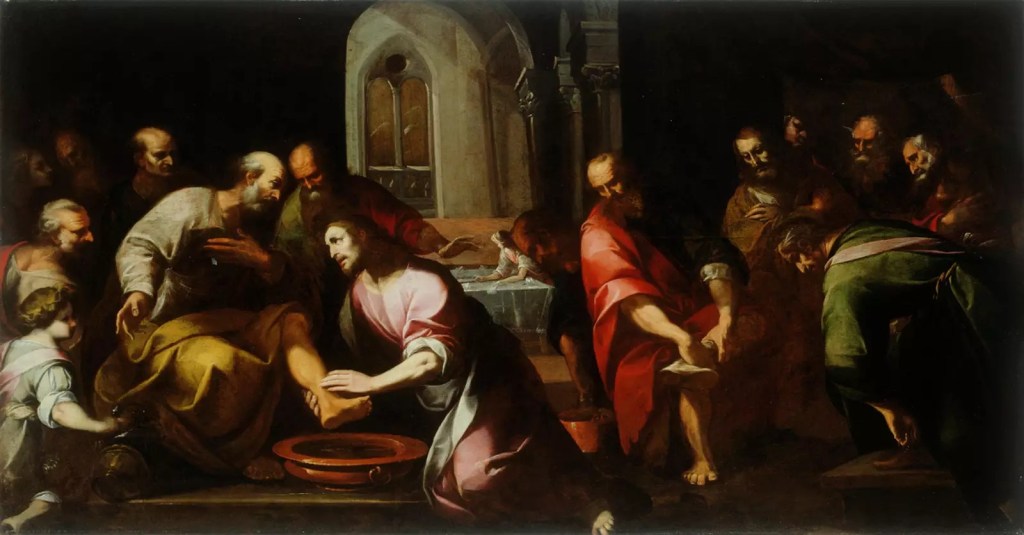
Jesus washed his follower’s feet to emphasise the importance of humble service, that Christians should seek to serve, not be served. Source.
I could go on (have you ever looked at what kind of company Jesus kept?), but we can hold it there. The example of Jesus’ life and his teachings lay a pretty clear picture of what ‘good deeds’ are: a good Christian is forgiving, gentle, and kind. They are generous and considerate of others, and broadly renounce both violence and wealth, even to their own personal detriment. The message is revolutionary, in that it is completely at odds with the worldview of power, status, and force that sits behind every empire, but it’s not a revolution won with swords or bullets. Christians should seek to serve others humbly like Jesus did, and always look to bring reconciliation and wholeness to people, rather than division or harm. Most of all, Christians should love others, just as Christ loves us all (Matthew 22:37-40). There’s so much more we can say, but that should be enough. If that’s Christianity, what’s Christian Nationalism?
In short, it’s a political ideology that seeks to fuse together Christianity with being American, and demand the State serve and protect Christian interests. The ideology is on the rise around the world, but has really taken root in America. The current Vice President of the USA is associated with the ideology, as are several officials in the Trump administration. Now, Jesus said that you know a tree by its fruit (Matthew 7:16-17), and we can see how Christian ‘Christian’ Nationalism is by looking at the actions of that administration. So far, they’ve sent armed gangs into the streets to seize and deport people. Officials have said empathy was a weakness and something to resist. The administration has funded a genocide killing thousands and launched military operations which killed dozens, if not hundreds, of people. Trump himself has said he hates his enemies. He also likes to flaunt his wealth and power, of course. Meanwhile, the Vice president’s poor understanding of Catholic doctrine earned him a rebuke from the pope, and Christian Nationalism has enough overlap with White supremacy for some to call it ‘white Christian Nationalism’ – despite the Palestinian and Middle Eastern roots of the Christian faith.

Not to imply anything, but I don’t think Trump’s ever been able to name his favourite verse of the bible. Source.
This isn’t Christianity, by any meaningful definition of the term.
Christian Nationalism drapes itself in the symbols and language of Christianity, but as an ideology it is absolutely at odds with the gentle, forgiving, loving way of Christ. There’s no room in the teaching and life of Jesus for imperial domination, for mocking the poor and vulnerable, for asserting racial hierarchy. Being Christian isn’t just about owning a Bible or going to a church – it’s about belief and action, about the transformation of the heart. It’s about the striving to become just that little bit more like Jesus, to dwell with God and be changed by the experience. The Nationalist might fall back onto their belief in Christ, but remember the Goats of Matthew 25 called him ‘Lord’ too. We know what Christianity should look like. The church often, often falls short of the standard, but Christian Nationalism is something else entirely. There’s a word out there for something pretending to be Christian to lure people in and twist the teachings of Christ. I won’t say it here, but I suggest looking into it. But one thing’s for sure: this ideology isn’t Christian, it’s one of the biggest threats to Christianity of the twenty-first century.
-The Teaspoon
 The Teaspoon Brigade
Leave a comment