We love narratives. As people, and as greater communities, narratives are so essential to how we comprehend the world around us. A compelling story of how things are, how they came to be, can be more powerful and more inspiring than a messy, awkward truth. For my own part, I’ve been deeply compelled by narratives. The narrative of my own life, how I came to be the person I am today. The narrative of my family, the stories of relatives I’ve never met and never will. The narrative of the world, the place in which I live. And it is because of that power I see in narratives that I can’t help but point out and critique a narrative of the world which I find in others too often: I’m tired of (historical) Determinism.
Is this a concept you know well? If so, you’re welcome to skip this bit, but for any who don’t, in history and storytelling (all history is storytelling) determinism is a telling of history which minimises human agency, and argues historical action emerges from external pressures and forces. You might have seen this version of history without knowing it A determinist might argue that the colonisation of the world in the 1500s to the 1800s was inextricably linked to, or even sparked by, an overpopulation crisis in Europe – or they might argue the cause was long-term changes in weather systems which caused crop failures and famine over decades. In the narrative of determinist history, human activity is driven by forces outside its control, usually inevitable and unavoidable ones: the realities of geography, economics, and ecology. There’s plenty of examples: that Egypt was a massive economic and political force in the ancient world due to its location, with protective deserts around hyper-fertile riverbanks, that had predictable flooding – but it fell away as other realms developed agricultural techniques. That German economic dominance was an inevitability due to the array of rivers and waterways to power industrial facilities. That Spain was the prime candidate for colonial expansion in the 1500s because its geography both protected it from European instability, and left it nowhere else to go. It not an uncommon way to explain history, but it’s one I have some problems with.
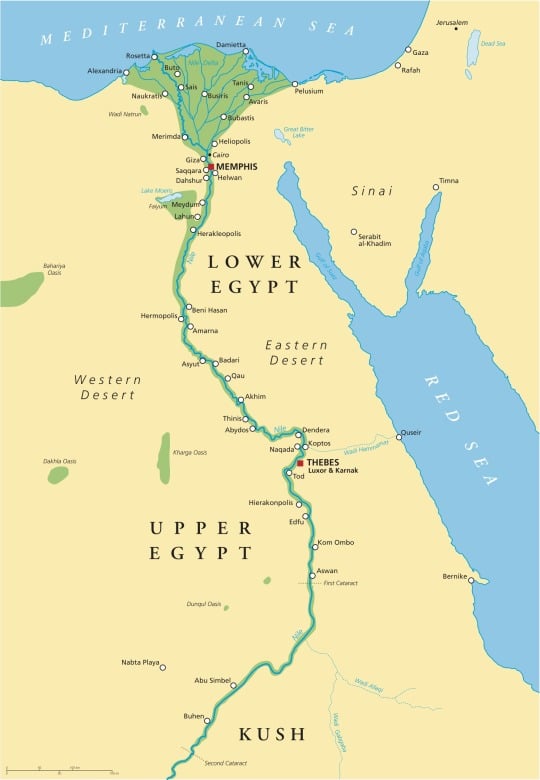
Was Egypt’s early success in antiquity simple due to reliable flooding of the Nile? Source.
Firstly, I’m not sure it’s accurate. I mean, it is a little bit true that human action is shaped by external forces like geography and economics, but it’s not the whole truth of history, and in telling this narrative we close off others, just as true and real as this one. Egypt wasn’t only a power in the ancient world before others had competing agricultural ability – it was the foundation of several realms in the medieval and modern period, from the Ayyubids to the Ottomans. Just because those powers weren’t Egyptian does not mean Egypt wasn’t an economic bedrock for major powers. German industrial output might seem inevitable from its geography, but in truth the closest historical connection might be that German industrial might burst forth once the region had more autonomy and agency – for much of Europe’s history, its population and output were lower than France and Italy. And Spain wasn’t removed from European politics during the heyday of its imperial force, it was utterly immersed in it. Why should a realm fresh off a seven-hundred-year intermittent war be less exhausted by conflict than the Germans, or the French, or the Irish? During the time its geography apparently ‘shielded’ Spain from European instability, it was fighting an eighty year war to prevent the Netherlands independence, launching raids into Northern Africa, and participating in the Thirty Years War.
Determinism tells a convincing story, but it leaves a good deal out. Of course, there’s plenty of ways to tell history, and you could like determinism anyway. There’s is nothing wrong with that. Or at least, there wouldn’t be anything wrong with it, but determinism carries some unfortunate baggage.
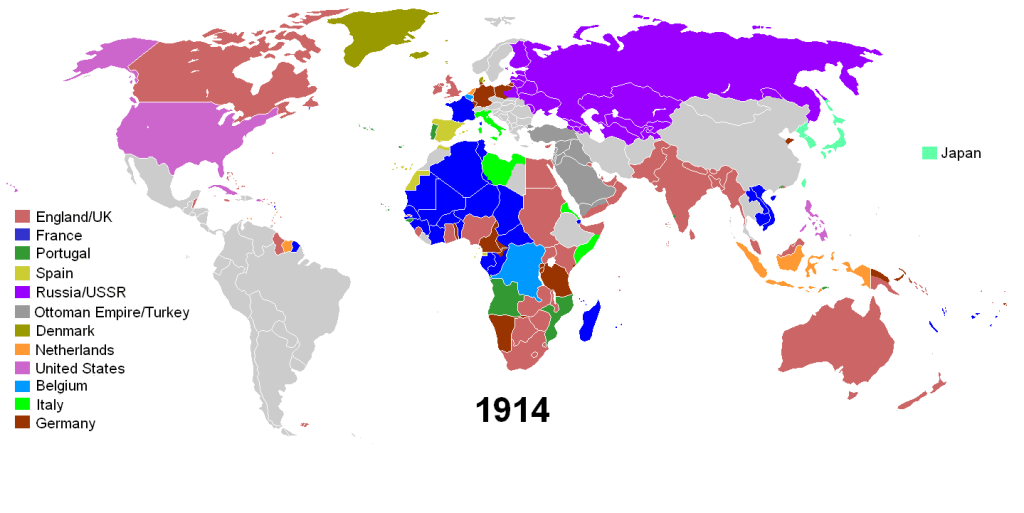
Determinist history is all fun hypotheticals until you ask if this was inevitable, and what that would imply. Source.
A problem with making history and human activity inevitable is that you make all of it inevitable. You can’t pick and choose which bits had agency and which didn’t – if we’re willing to use ecology to explain why one war happened in the Summer, we can’t overlook the fact another happened during a different heatwave a century later. We can’t use overpopulation as a reason to explain historical forces, then be surprised when someone else argues that’s why people are migrating today. The reality of history is that it is littered with atrocities and violence. There have been invasions, conquests, famines, genocides. We risk shrugging our shoulders and tossing questions of justice in the bin if we reduce it all to inevitable forces outside our control. We can naturalise the horrors of the past and in doing so, justify them.
And there is a deeper, more insidious layer than this. Over the past five hundred years, white Europeans have successfully conquered and subordinated peoples around the world. Uncountable volumes of wealth were extracted and stolen, and entire peoples were dispossessed so white Christians could settle on their land. I wonder, what are we actually saying when we call this process inevitable? What, perhaps, made it ‘inevitable’ that whites would dominate the world in this way? We might not be using the language of white supremacy, but the principles of it are there, plain enough to see.
Then there’s the issue of restitution; nobody expects the sea to pay a fine if a king tide floods a street. We don’t expect the Pacific plate to appear in court over its tectonic activity and the earthquakes it causes. We don’t convict a wildfire for manslaughter or property damage. Natural forces do not receive ‘blame’ for the things they do, because there was no agency, no active actor making a choice with alternatives which should have been taken instead. So what happens, when human action and choice is subordinated below geography and economics? How are we to hold Empires accountable for their actions, if we say they were facing overpopulation and difficult weather systems that forced them to act in the way they did? Regardless of whether it is true that human action and choice exist freely, we must insist upon it, because without that we can’t assess ‘right’ and ‘wrong’ at all – after all, it’s generally unfair to punish someone for something they had no choice over.
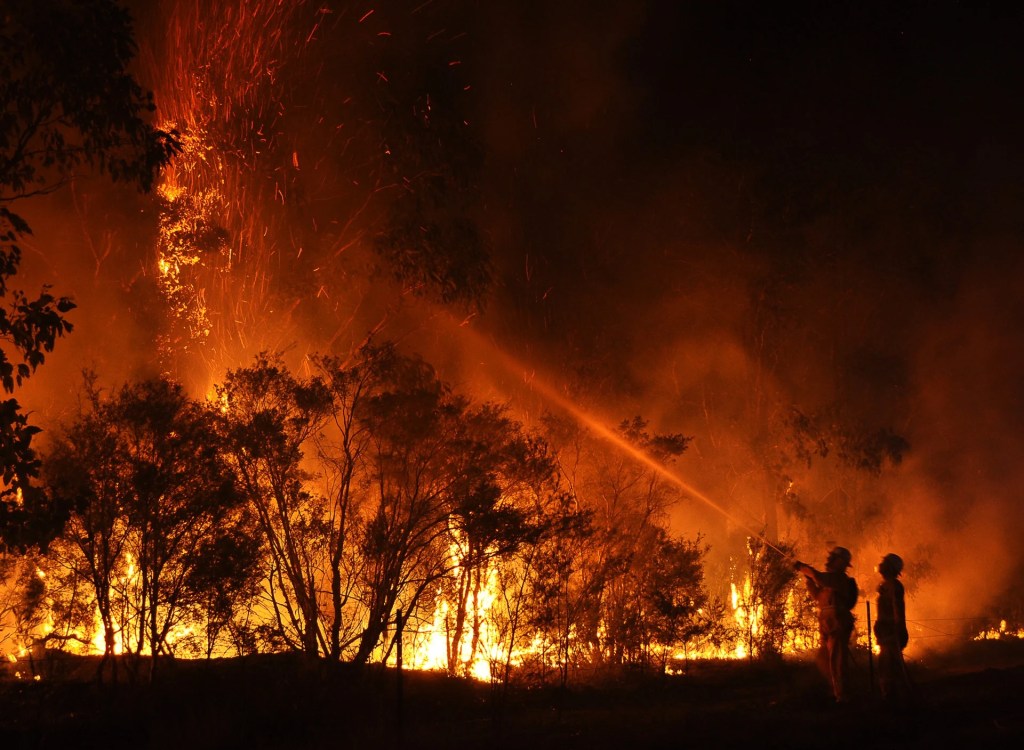
Pictured: something which can’t be made to appear in court, or pay a fine for property it destroys or people it hurts. Is this how we should think of things like occupations or wars? Source.
But if we cannot affirm that some actions were wrong choices, things that should and could have been avoided, how can we argue for justice for the dispossessed? Is it a coincidence that such a deterministic view of the world is (I find) usually found among people in imperial countries? The marginalised don’t want a narrative of determined action, because it reduces their pain and trauma to something inevitable that nobody in particular is responsible for. But if we were to treat the wrongs of history as choices, as defined actions real humans made and could have not made, then we can recognise historical wrong, accept responsibility, and work towards actual healing. If someone planted a knife in your back, then insisted it wasn’t their choice because of the determined nature of the world, that wouldn’t be much help, and it would probably feel like they were just trying to avoid accountability.
The last thing to stress is a warning. Empire wears many masks, tries to cover its excesses and atrocities with numerous justifications. One of these is naturalisation, the insistence that whatever ills we can lay at the feet of a given empire, these were just the rational, self-interested actions of a realm, natural instincts like that of a lion or a bear. And there is a reason imperial justification works like this. If it can be justified as a natural force, empire can legitimise itself. If we’re all convinced empires and their atrocities are natural, normal parts of reality, then there’s no way to get rid of them, even if we do agree they are unpleasant.
But we can be rid of empire and injustice. Humans have lived for tens of thousands of years without empires, and in our imaginings of a utopian future empires have usually been dissolved. But if we are to achieve such a future, we have to first get rid of systems of power and domination over others. And to do that, to prevent empire’s self-justification as rational and normal, we have to insist that history isn’t inevitable.
– The Teaspoon


 The Teaspoon Brigade
Leave a reply to T.B. Cancel reply