I have a pitch for you.
Are you tired of modern TV shows, with bloated budgets, small seasons, and a frustrating habit of being cancelled way too soon? Are you over media that is aggressively pessimistic about humanity and its setting, and actively punishes you for caring about characters? Do you sometimes wish for media that gives us something to aspire to, rather than hitting us over the head? Do you just want an easier time choosing what to watch on a lazy evening? Because do I have the TV show(s) for you!
I get it, you’re hesitant. You know the franchise has some really intense fans, and you’re heard that it’s both very sci fi and nerdy, and that it’s often very silly or low-budget. I was pretty hesitant myself, before a good friend encouraged me to start watching with them. Five years on, I’ve watched all of The Next Generation, all of Deep Space Nine, most of Voyager, and a smattering of other Star Trek like Strange New Worlds and Lower Decks. I went in out of curiosity and ended up neck deep in Star Trek, and honestly – I don’t regret it. So hear me out and let me set the scene for you, if you’ve not watched any or if you only know the original 60s run, because the franchise has done a lot since then. I won’t say that Star Trek is the best media of all time, though I do think DS9 is some of the best TV I’ve watched. But what I am certain of is that Star Trek, especially 90s Trek, is something we need right now. Let me explain.
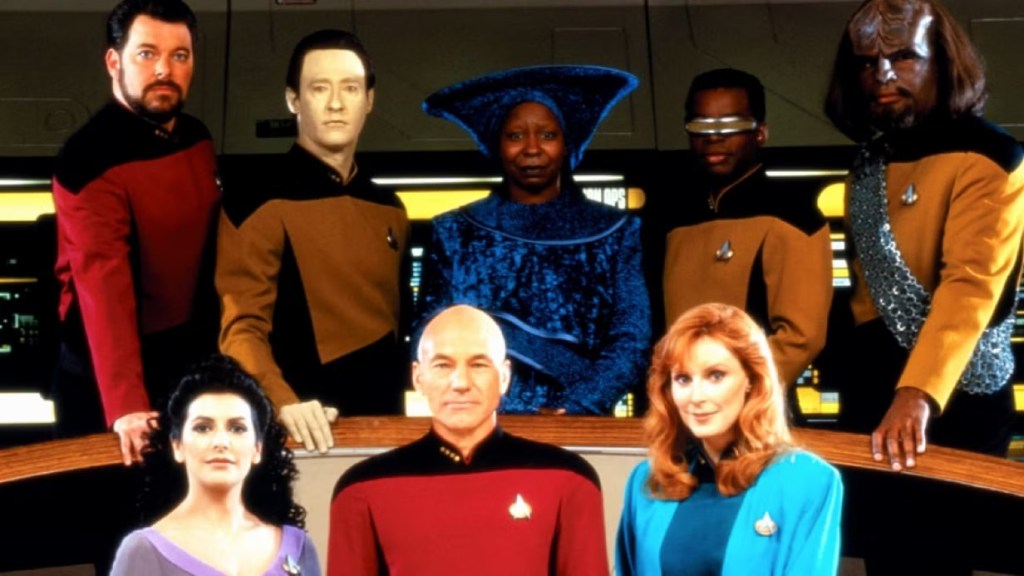
These shows celebrated diversity, kindness, curiosity, and technology while condemning authoritarianism, violence, and greed. The future where everyone can thrive. Source.
The world of Star Trek is set hundreds of years into the future, with most shows taking place in the 23rd to 24th centuries. Humanity has become a space-faring people, part of a larger collection of planets called the Federation of Planets who work together for mutual benefit. The Federation is multicultural, multiracial, and generally heroic, with the galactic region filled out by other powers like the Klingons, the Romulans, and the Cardassians. The first thing Trek offers us which we sorely need right now is a genuine, optimistic view of the future. In the Federation, prejudice and bigotry are largely of the past – actually, so are concepts of money and private ownership. Right-wing Trek fans will hide this from you, but the Federation are a bunch of socialist space vegans. Episodes emphasise again and again that it was only through progressive politics that humanity was able to reach this utopian future. So, Trek is not just a future where humanity actually thrives, but specifically it thrives through progressives winning.
Not that the process was easy, mind you. In the lore of Trek, humanity had a very dark 21st century, which was preceeded by ‘the Eugenics Wars’ and saw World War Three, which cause a nuclear apocalypse and killed hundreds of millions. It was in the aftermath of this, as humans rebuilt society, that it was determined to move away from capitalism and systems of oppression, instead creating a world where everyone would succeed. No matter how grim or dark our current moment is, Trek is a reminder that all is not lost, and we can still achieve a better future. Even if the powers that be now drag us towards chaos and darkness, there will be a tomorrow and an opportunity to rebuild better. Hope is powerful, and we shouldn’t let it be taken from our hands.
We need to be able to articulate what the world will look like if, and when, progressive ideas take root and succeed. We need the ability to believe in ourselves and our values.
There’s not a lot of media which is so openly and confidently optimistic about both people, and progressive ideas. I’m not opposed to sci-fi critique; The Expanse is great too, don’t get me wrong. But we can’t only watch The Expanse. The things we watch and the stories we tell will shape what we see as possible and impossible. We need to be able to articulate what the world will look like if, and when, progressive ideas take root and succeed. We need the ability to believe in ourselves and our values. Otherwise we’ll always be twisting in the wind, a voice decrying the horror around it but never able to seize power and control away from those who hold it. And few things tell the story of progressive victory as well as the Star Trek of the 60s and the 90s.
This might come across as me reading too much into it, but this is all intentional. From the earliest days, the shows were made with the intent to explore ideas, to paint a positive future – though the show runner had some problems we shouldn’t overlook. It was about showing a humanity where racism and sexism weren’t everywhere, a culture that wasn’t obsessed with wealth and consumption. It was about challenging conservative norms and beliefs. This is what the directors, the writers, and the actors wanted. They purposely chose to have a man of colour as the lead in DS9, and a woman captaining Voyager. They were deliberate in showing Geordi living a thriving life with a disability in Next Gen, rather than the ableist vision of people with disabilities being screened out of the human genome. If you step into the world of Trek, you’ll find it’s full of social critique, of forward-thinking ideas (though I won’t say it’s perfect), and earnest in its vision and hope. I’ll take that over the myopic cynicism of things like Game of Thrones any day.
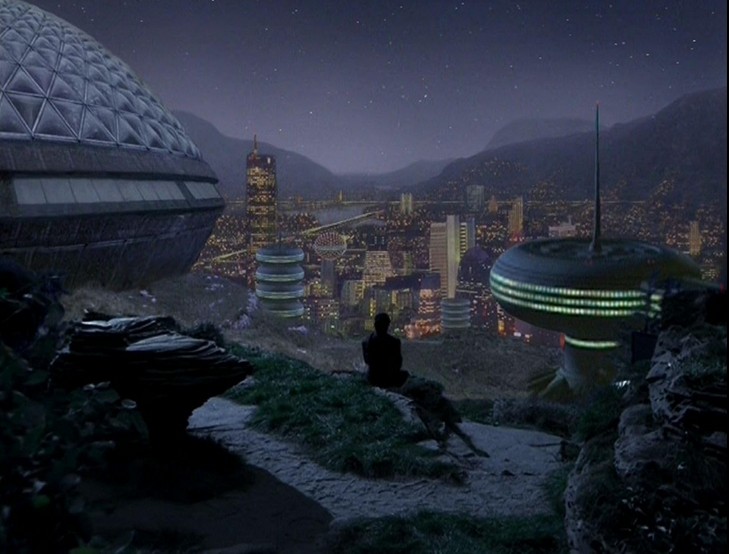
I’ll take a campy show that genuinely explores ideas over a glossy, pretty program with nothing of substance to say anytime. Media should have themes, not just seek to punish the viewer. Source.
But my recommendation is not just about politics. The shows are fun! Yes, they are at times dense and at times extremely silly, but that’s not a bad thing. Star Trek shows like to ask philosophical questions and explore heavy topics, and the fun camp episodes become extremely important breaths of fresh air between explorations of cults and trauma or the machinations of fascism. The shows have ensemble casts of actors having the time of their lives, it’s not hard to grow attached to characters. The make-up and practical effects are great, the editing and direction are always fun even when camp, and at its best the writing is outstanding. It’s good TV! There’s a lot to enjoy.
In fact, there may even be too much to enjoy. The three mainline shows of the 90s (TNG, DS9, Voyager) each ran seven seasons with over 150 episodes each, and episodes run about 45min. There’s a lot of it. This can make starting Trek daunting, and I respect that. However, there are a few upsides to the volume. Firstly, it means you have TV sorted for the next three to five years as you work your way through it all – no more spending 20 minutes deciding what to watch with dinner as the food gets cold. But it also gives the characters and writers so much time to breathe. You don’t realise how rushed and cramped TV is today till you watch a show that spends whole seasons gradually establishing and building an arc, or a dynamic between characters. Many characters in Trek have a lot of depth, a lot of hidden corners to their personalities and belief systems, because the show has the time to give that to them. Not every episode has to be life-or-death. The actors and writers can have fun, or take the time to explore a premise fully.
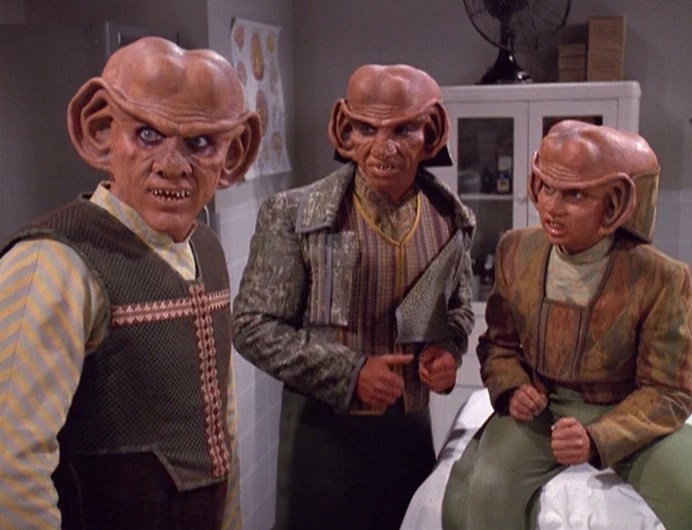
The Ferengi of DS9 go from being a simple parable about the ills of capitalism and greed to a fleshed out people with distinct culture, laws, and traditions, which develop and adapt over the shows run. They may look ridiculous, but all of them have incredible arcs. Even Rom. Source.
Okay, maybe it is still a lot to take in and it’s hard to know where to start. I can help with that. Start with The Next Generation, and watch that. It’s probably the most popular Trek show, and several shows after it either emulate or challenge it in fun ways, so this gives you a good grounding point to start with. When you’re finished TNG, or if by season six or seven you want some more critique of the status quo that show presents, DS9 is again one of the best TV shows I’ve watched, and it does a lot of positive criticism and challenge to the world of Trek. Maybe a controversial view, but Voyager is honestly really great and fun, and worth watching, but it’s set up needs a little knowledge of DS9, so it could be worth watching some of that first. Or just look up a guide, other people smarter than me are on this.
In 2026, the world is getting pretty scary. There are wars and genocides. Prices and inequality are going up, and over coming decades life expectancy and quality is predicted to come down. We’re facing so many crises it’s easy to forget the Climate Catastrophe on the horizon, consistently closer than we’re willing to accept. Star Trek offers hope. The earnest belief that things can and will get better, and that progressive ideas will triumph in the end. As we drown in a dystopias and pessimistic doomerism, it’s campy joy and hope is a vibrant change of pace. We need Trek and things like it to encourage us to keep up the fight, and keep coming back to that basket with teaspoons of sand.
– The Teaspoon


Leave a Reply