Our lives are full of stories. Narratives we tell about ourselves, about our lives, about the world. One story I’ve heard again and again, retold for decades now, is that of “Progress.” You know this story too, though maybe not through a formal telling. This is the narrative right now the world is the Best its ever Been, that ours is a golden age of health, comfort, and luxury. The narrative that for most of our history, life was ugly and brutal and short, but that we’ve overcome this. The narrative that we’re just about to turn the corner and arrive at a beautiful utopia. That almost all the systemic problems of inequity like hunger, poverty, war and prejudice are rapidly declining. It’s a compelling story. But I don’t think it’s true.
I’ve started to wonder if we don’t actually live in an age of Progress at all, but in the time of Fauxgress – the performance and mimicry of development to cover and hide persistent injustice. The Powers that Be know they’re supposed to be working to end poverty and oppression, to be making the world better, and we’ve come up with charts and rubrics which follow the story, but there’s ultimately a lot of sleight of hand. Governments and Corporations act like magicians, confident our eyes are too slow to notice that the behind all the grand gestures and big numbers, is the same machinery of misery, left largely untouched.
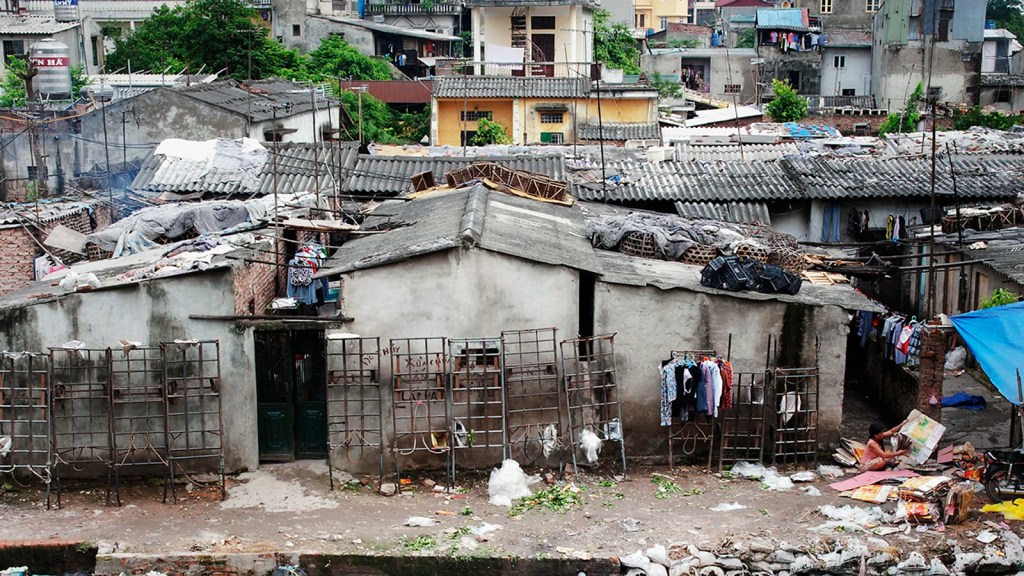
Don’t get fooled by all the self-congratulation from politicians – the UN goal is to eliminate poverty “in all its forms, everywhere.” If we end extreme poverty by moving people into mid-range poverty, we’ve failed our goal. Source.
This is maybe a bold thing to say, and I doubt you’re convinced just yet. We have medicine and Women’s rights now I hear you say; literacy and income are up, poverty and hunger are down. How can this be fake? Well, some of it is very real. There has certainly been progress for a number of minority groups in the past century or two. Then again, we’ve also seen some of that disappear in recent decades. Nations have overturned women’s rights; programs of social support have been gutted; and far right movements have been gaining traction. So it isn’t the case that nothing good ever happens, so much as that there’s always some movement forward and back in topics of justice. Slavery and segregation and colonial empires and fascism have all been ‘dismantled’ in the recent centuries, but saying this can obscure that they also began in the past five hundred years of the Imperial Project – modern history shouldn’t get points for solving problems it created.
So don’t think I’m saying everything was better ‘back then’ – just step back and look at the world with me. We say our world is seeing and end to poverty and hunger. How do we define those things?
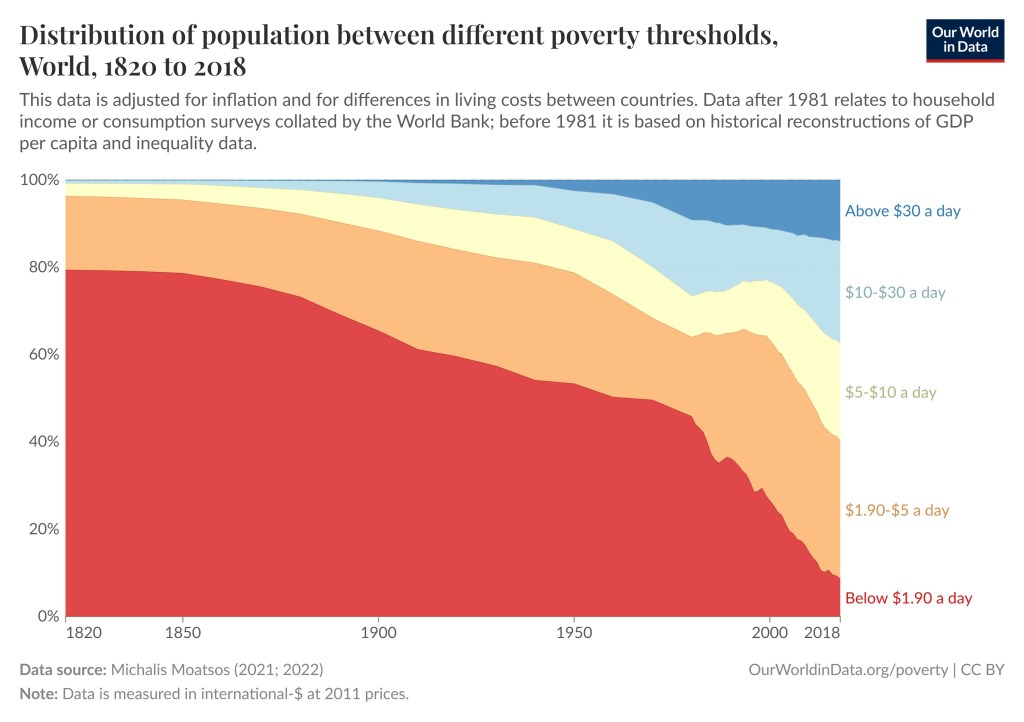
Don’t want to dwell on this, but I should mention that a separate problem with thinking about poverty in dollar numbers is that it doesn’t account for social context – getting $5 per day with free housing might be better than $25 per day with rent or mortgage, for instance. Source.
It’s not hard to find charts like this one, and you can see why. Four in five used to live below $1.90 USD in 1820 – now only one in ten do! The thing is though, even if this data was true, poverty isn’t defined like that. Poverty isn’t when you’re under a dollar-per-day threshold: per World Vision it’s “the severe lack of certain possessions which significantly reduces the quality of a person’s life… having limited access to food, clothing, healthcare, education, shelter and safety,” while per Habitat for Humanity it’s where it is impossible “to meet basic needs of life including food, shelter, safe drinking water, education, healthcare, etc.”
Be honest with me: do you believe only ten percent of the human population is lacking the basic needs of life? Is ninety percent of the world receiving adequate food, shelter, water, education, and health? We tend to only talk about ending poverty in its most severe form, and in dollar values. Instead, for a moment let’s look at a case study for actually getting life’s essentials.
As of 2025, In the United States approximately 11% of Americans were considered in poverty, over 35 million people. For the richest country in the world, this is already deeply alarming (The US uses over $27 USD per day as the line, owing to relative costs and incomes). That said, around 35% of Americans struggled to access affordable healthcare, and 26.7 million were uninsured. There were 770,000 unhoused Americans, who must be in poverty by default. 42 million Americans relied on government food programs to have enough food, and 44 million were drinking potentially unsafe water – in fact, it’s estimated 165 million Americans were exposed to unsafe water. Half of all renters in the US were paying too much for their rent (defined as over 30% of their income), and 74% of American households could not afford the median-priced home of $460,000 in 2025. So depending on how you weigh these numbers, millions of Americans are still impoverished – the official poverty line’s just been drawn below them artificially.
In reality, the narrative of eliminating poverty happens by being loose with definitions. The $1.90 (now $2.15) line was set arbitrarily, and there is lively debate over what number would better reflect the amount of money needed to meet life’s necessities; though almost all scholars agree the current limit is far too low. And of course, the moment the line begins to move our fauxgress vanishes in smoke: 8.3% of the world lives on less than $2.15 per day, but 23% have less than $3.65. Raise the line a little higher, and 47% are on less than $6.85 a day, and 50.6%, 4.2 billion people, were under $7.40 per day, this being the amount of the “ethical poverty line” which would allow the poor to have a normal life expectancy. As Current Affair’s Roge Karma pointed out, using a $7.40 line, world poverty declined from 71% in 1981 to 58% in 2013 – an achievement, but hardly the rousing victory described in the myth: and in that time, one billion people were added to the globally impoverished as the world population increased.
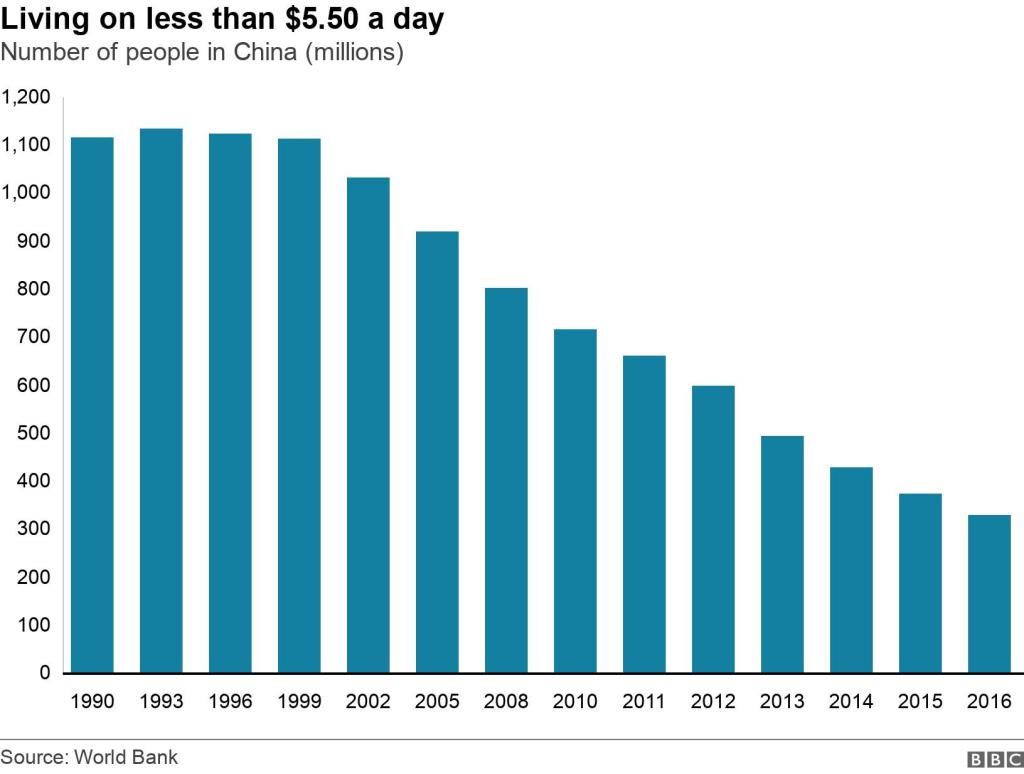
Whenever we’re looking at these kinds of statistics, it’s also worthwhile to ask how the success we’ve seen has been made: for instance, a lot of the ‘progress’ in ending poverty over the last century has come from East Asian countries like China, who notably did not follow the business-friendly, corporate model. We’ve had some success in ending poverty, but neoliberalism wasn’t the cure. Source.
This is just one example of massaging statistics to support the legend of Fauxgress. What about hunger? Well, it was estimated 8.2% of the world, some 673 million people, were hungry in 2024. However; 3 billion people couldn’t access a healthy diet, 2 billion didn’t have safe drinking water, 2 billion had at least one nutrient deficiency (if not more), and 2.3 billion had moderate or severe food insecurity, meaning they couldn’t access enough food to meet their needs. I might be being unfair here, but I’d say by these numbers the number of people on earth who experience “hunger” is less one in eleven and closer to one in four. What about war? We’re told fewer people are dying in fewer wars, and that ours is the era of the “Long Peace,” especially compared to violent anarchy of history. But there’s another trick at play here, because while certainly the number of people dying in war as a ratio of our population has gone down, that’s mostly because China and India specifically haven’t been at war much since the end of World War Two, and currently have a combined population of almost Three Billion People. If you look at how many people are dying in the actual wars themselves, as a ratio of the countries actually involved and not also including people on unrelated continents, modern warfare is horrific. It frankly deserves an article of its own. The only reason we don’t notice is because it’s not happening on our soil, and because a few regions of the world have been following peace. But that can end anytime.
Why does this matter?
Because Fauxgress will be trotted out everytime you start talking about changing the world too much. Because this narrative lulls us into inaction, when the world is actually rife with misery and injustice.
Because if we aren’t in the Golden age, things need to change soon.

On War; the Thirty Years War killed up to 8 million people, or 266,600 per year, in a population group of 64-72 million people (up to 417.5 per 100k, per year). By comparison the Second Sudanese Civil War killed up to 2 million people over 22 years in a population group of up to 20-32 million (up to 455 per 100k, per year). When and Where war happens today, it is devastating and you shouldn’t trust someone who suggests otherwise. Picture Source.
I don’t think it’s quite as challenging to assert this today as it was a few decades back. Even in the West, people have been forced to witness genocide and mass killing, starvation and insecurity. But we need to follow through on dismantling this way of thinking. Climate Change is bearing down on us; the way of life, the socioeconomic system which is “ending” poverty and hunger is in fact actively destroying the planet. We’re not saying there’s nothing worth preserving about the present, or real victories to celebrate. But they’ve come despite the Powers that Be and the systems of Power and Commerce, not because of them.
We tend to break history into smaller and smaller eras as they get closer to our moment, but the way we remember history now isn’t how it will be told in a thousand years. Like it or not, ours is the era of colonialism and chattel slavery, of World Wars and genocides, of ecological disaster and hyper consumption. We’re not ending inequality or poverty, Patriarchy or White Supremacy. These things festered out the bright lights for a time, but they aren’t beaten. And often when they are, it’s only because we’ve kicked the problem somewhere else. In the West we have Plenty, but only because we put others in misery. This isn’t “Progress,” it’s a tragic farce, and Fauxgress is something we’ll need to shed to actually Build a better tomorrow.
– The Teaspoon

 The Teaspoon Brigade
Leave a reply to JustThinking Cancel reply