This piece is in something of a follow on to the previous post on whether we live in the Golden Age of Humanity – if you haven’t read it, it could be good to read that first before looking at this. To sum up, I for one have found it harder and harder to believe that our world genuinely is a Golden Age, and really much of our recent ‘progress’ has been more performative and technical than material – a ‘Fauxgress’ which serves to mask real misery being inflicted. The following is a focus on this, as seen in warfare. Enjoy.
One repeated argument in support of Business as Usual and our current Status Quo is that right now, wars are less frequent, less lethal, and generally better than they used to be. It’s a crowning achievement alongside the reductions in poverty and hunger, that the horror of violence and battle is being steadily squeezed out of our world, that more and more of us enjoy peace rather than war. It’s a pretty easy argument to state (there’s less war and less dying in war!), but it’s also surprisingly dense as arguments go and blends together a few different ideas. When we talk about how ‘bad’ war is or isn’t, we’re really talking about a few things at once:
- How many wars are happening?
- How many people are being exposed to those wars?
- How deadly and destructive are the wars that are going on?
It’s important we split apart these concepts, just in case it turns out that they don’t all move together – you never know. But before we dive in, we should give some attention to the narrative of ‘good’ modern war, if only to better understand it.
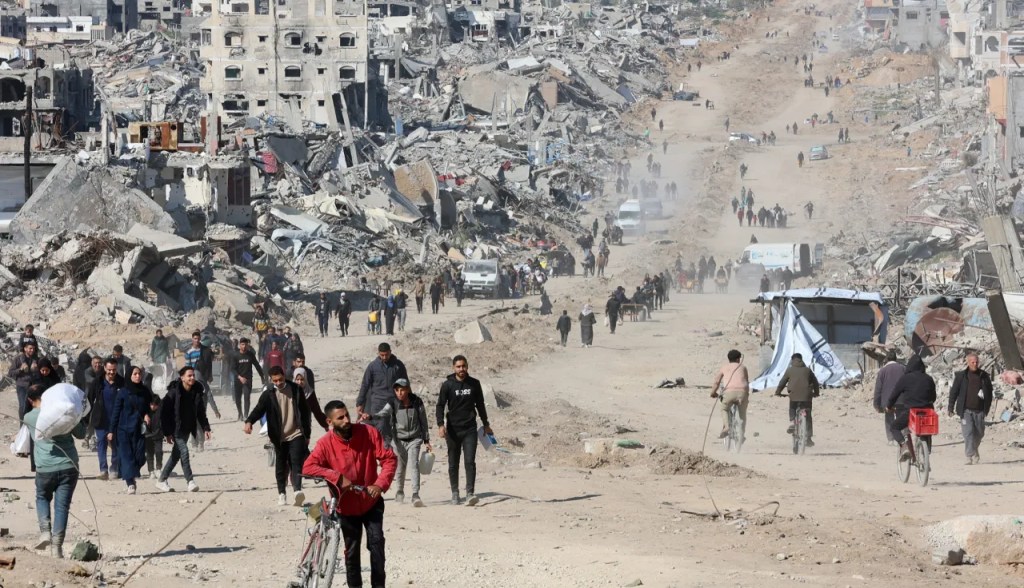
Pictured: some potential album art for the 2026 edition of Now That’s what I Call International Peace. In an actually peaceful world, our limits and safeguards on war wouldn’t be getting dismantled in real time. Source.
It’s not hard to find people arguing that the lethality and violence of war is declining – there are whole books like Steven Pinker’s The Better Angels of Our Nature asserting it, reports which confirm it, and plenty of graphs charting what looks like a steady decline in war deaths: some are pictured here. Quite often, the decline in war and war’s lethality is drawn only since the end of the Second World War, or in the past couple of centuries. One reason for this is that all these war statistics are hazy and speculative: consider how much variance there is in estimates of loss of life from wars happening right now – the problem only gets worse the further back you go. In any case, some scholars call our period the “Long Peace,” considering human history since World War Two to be one of the most enduring peaceful times ever. The argument goes that war (and violence in general) is a horrid thing that civilising influences have steadily fought and in our times, almost defeated. We have fewer people dying in fewer wars.
That’s the claim, anyway. Does it hold up?
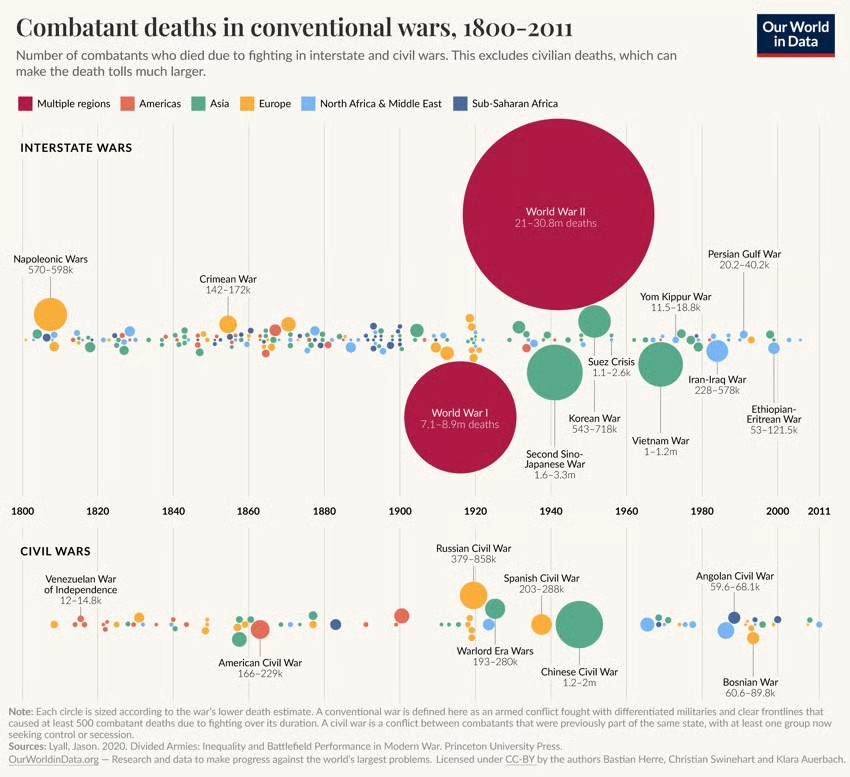
For emphasis, this chart only counts combatant deaths, and uses lower rather than higher estimates; two factors which heavily lower the tolls listed. Source.
Let’s review those three questions above. Are there less wars now than there used to be? Frankly, this is mostly a game of definitions. Depending on how you count them, there are somewhere between a handful to over a hundred wars and conflicts raging at present; it’s hard to compare with certainty, but it’s likely that this would have been true through most of history as well – the history of war is full of minor skirmishes between low-level lords that never escalate to a proper war, just like we have outbreaks of localised violence today. At the least, we can confidently say modern war isn’t any more frequent than it used to be, and it’s reasonable to guess there’s less wars today – so long as we accept it’s a guess. The second question is pretty easy to answer: we can say with great confidence that less of the world experiences war today. In 1500, the world population was 425-550 million, and realistically pretty much everyone was affected or exposed to war in some war or another – there’s no immediate “peaceful” land not seeing war break out. In 2026, the world population is 8.3 billion and, depending on definitions, 1-2 billion of them experience war and armed conflict. So while the raw number is up, there’s now billions who don’t experience war.
While that is great for humanity, we shouldn’t award points to “Progress” and its advocates just yet. While it looks like that we’ve gone from basically everyone experiencing war to only a quarter or an eighth being exposed, we have a problem of outliers. Around 3.4 billion people live in Latin America, China, and India, three places which haven’t experienced any ‘war’ and little conflict in the last thirty years. So is “the world” more peaceful? Or is it China, India, and Latin America? If there is a civilising force preventing war, we don’t find it America or Europe but in South and East Asia – so why is it the proponents of the Long Peace always look to the USA? But whatever the reason for it is, we can confidently say that fewer people are exposed to war today than in history, as a ratio of our population.
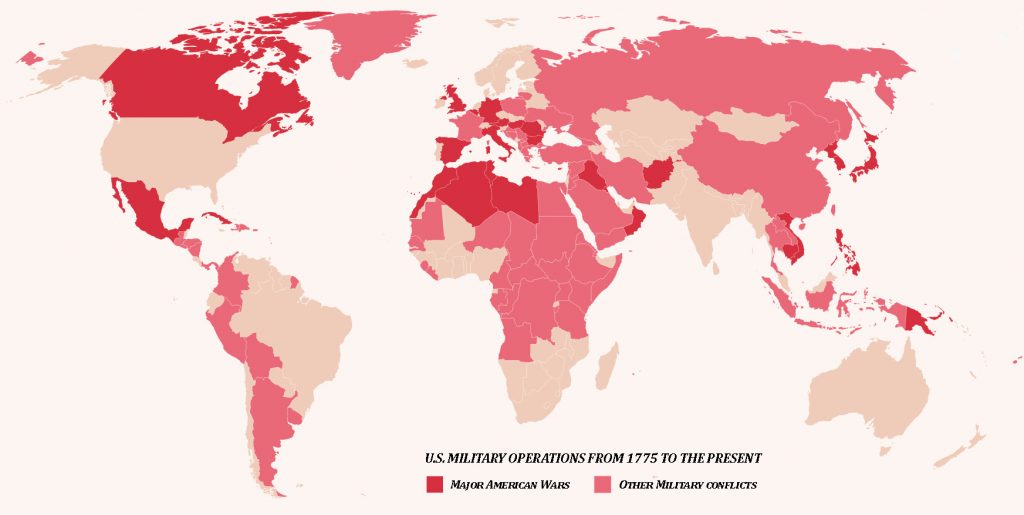
I just find it hard to imagine this as the face of peace and prosperity. To the credit of the US, some of these countries saw operation in genuine efforts to assist them (such as liberation campaigns in WW2). But still. Source.
Now comes the hard question: are wars less lethal than they used to be? If we were to look at all the deadliest wars in history, we would find that most of them are from recent history. With a handful of exceptions, almost all the world’s deadliest wars happened in the last 250 years, and most of those in the last century. However, it would be unfair to just look at the raw number of deaths, because the world is a much bigger place now than it was 1,000, 500, of even 200 years ago. Because of that, it’s common to look at the ‘deadliness’ and lethality of wars by comparing the death tolls to the world population. Do this, and the trend inverts: outside the exceptions of the World Wars, almost all the deadliest wars in history are very much historical, often dating back to before even the early modern period. The Mongol Conquests, the Reconquista, the Hundred Years War, the Thirty Years War; these are the real deadly conflicts of history. Pinker and others rejoice.
But of course, there’s a couple of problems with this way of reading the history of war and lethality. By being careful with how we present our data and information, we can make anything look good – this is the sleight of hand on which all Fauxgress rests. The first big problem with the above method is time. For example: at least 6,000 people have been killed in Iran in the ongoing war launched by the USA and Israel. As many as 15,000 were killed during the unrest in Libya after 2014. Which is deadlier? Well, one of these conflicts is barely two months old, while the other lasted almost six and a half years. One of these numbers comes out at 3,000 killed per month, while the other is at 195 per month. Which do you think is more lethal? And to make matters worse, a lot of historical conflicts lasted decades, if not centuries. Any comparison of death toll to population will skew towards these unless we keep an annual death toll as well as the raw total of lives lost.
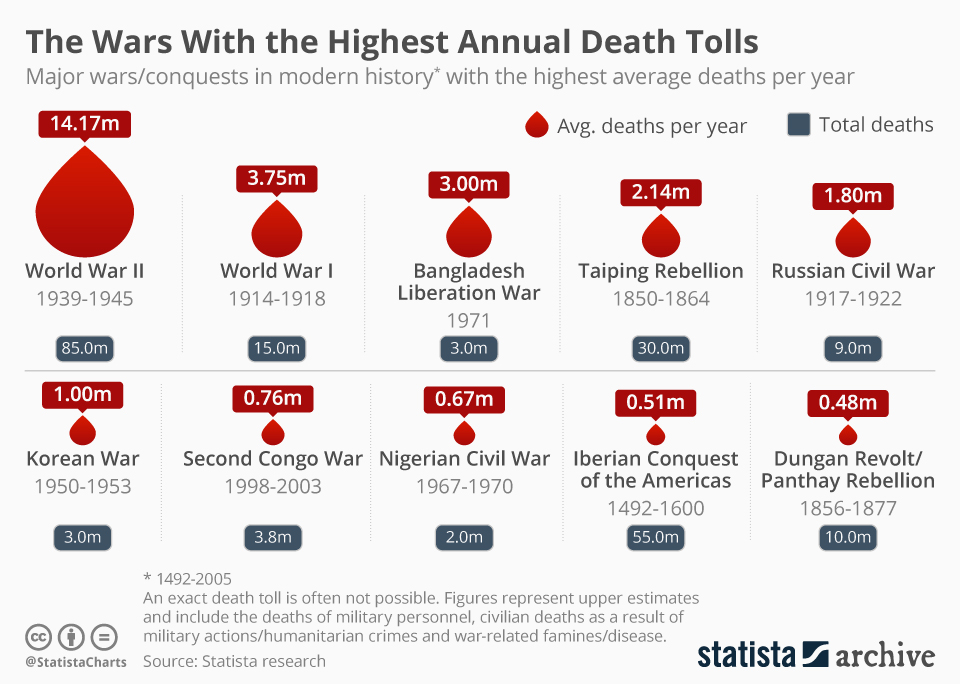
These figures illustrate how much time can skew how deadly we perceive a conflict to be – note however, that several of the above do not use the highest death estimates. Source.
Another wrinkle to add to the problem of war’s lethality is the population of those involved – a conflict which kills 10,000 in a population of 200,000 will have a much bigger impact on the community than the same death toll in a population of 20 million. In the example of Iran, the human impact on Americans (officially, 15 dead and over 200 wounded from a population of nearly 350 million) is much lower than it is for the Iranians (3,000+ from a population of 93 million) or the Lebanese (2,600 killed from a population of under 7 million). This is to address the outlier problem we noticed above: if we only think about the world population, almost every single war since 1945 will appear less lethal due to China and India existing peacefully somewhere else. That’s not helpful, and to understand how violent a war actually is we should aim to use the population estimates of the war’s participants, not people in unrelated countries or continents.
So, as a rough way to think about how lethal wars were and are, we might consider the annual death tolls and put them into context with the participant populations, rather than the world population. Rather than just calculate it as a percentage of the population (since that fluctuates naturally, especially over long periods of time), we can look at the rate of death per capita – per 100,000 people, how many were dying in a given conflict per year?
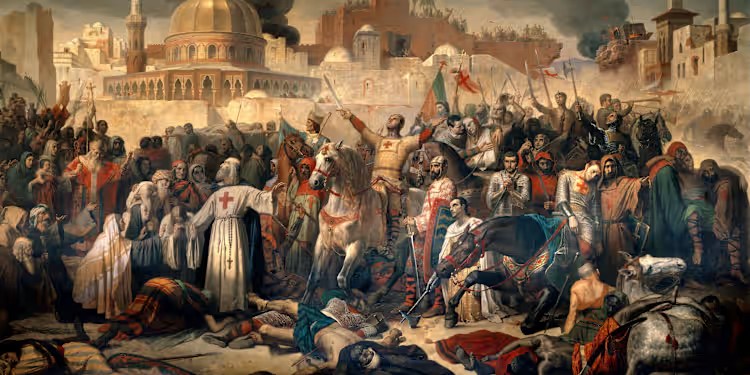
Pictured: the First Crusade’s sack of Jerusalem, a historical war crime of the crusades, a conflict which somehow ended up being one of the less deadly conflicts calculated for this piece. War sucks. Source.
Let’s do an example. The Crusades were a major conflict of the Medieval period, a war and period we often associate with violence and brutality. Estimates of deaths from the crusade’s ranges from 1 million to 9 million (I did say the estimates would get bigger!). Let’s use higher death count, hopefully accounting for more of the indirect deaths of disease or famine stemming from the violence. The crusades took place from 1096-1291, almost two hundred years. That would give an annual death toll of 46,154. The conflict involved almost all of Europe, North Africa, and the Middle East, a population estimated at 63 million in 1200 (roughly the mid-point of the conflict). Using the 1200 population, this would place the annual per capita death rate of the crusades at 73 people per 100,000.
Of course, other historical conflicts do give higher death rates: the Mongol Conquests killed up to 60 million people over 162 years, across Europe and Asia – an estimated 131 people per capita annually. The Hundred Years War killed 3.5 million English and French over 116 years, out of a population estimated at just over 18 million in 1400. That would give an annual death rate of around 162 people. The Thirty Years war has a rate of 417 people, the Napoleonic Wars 361, and the initial colonisation of the Americas as high as 864.
Now, modern wars.
Using participant population estimates, the First World War has an annual death rate of 1,009 people. The Second World War is at 708, the Second Sudanese Civil War at 476, the Second Congo War at 359, the Korean War at 136, and the recent Syrian Civil War at 202. The Russian Civil War might be one of the deadliest wars of all time by this metric, with a death rate of over 1,400 people, if not for the Nigerian Civil War, which has a death rate over 2,000. So, the short answer, by this measure at least, is no. Modern War is not less deadly than the wars of the past – in fact, modern war is frequently more lethal.
Why do we have this narrative then? Well, for one thing it is true that fewer people experience war, and that peace is more common than it used to be. This gives us a feeling that war is getting ‘better’ and so it’d make a kind of sense if it was killing fewer people too. We also tend to only talk about war and conflict in raw tolls, which will give longer conflicts a larger footprint than the kind of short, sharp conflicts of recent decades. We also tend to have a pretty narrow picture of what “modern” is – for most of us, wars from the nineteenth or twentieth centuries barely feel contemporary at all. But that’s partly through arbitrary distinctions of when ‘modern’ is, and people won’t break recent history down into decades the way we do now in five hundred years. Most, nearly all of the ‘modern’ conflicts I’ve listed were in living memory in 2026. They’re contemporary history, whether we’d like it or not.
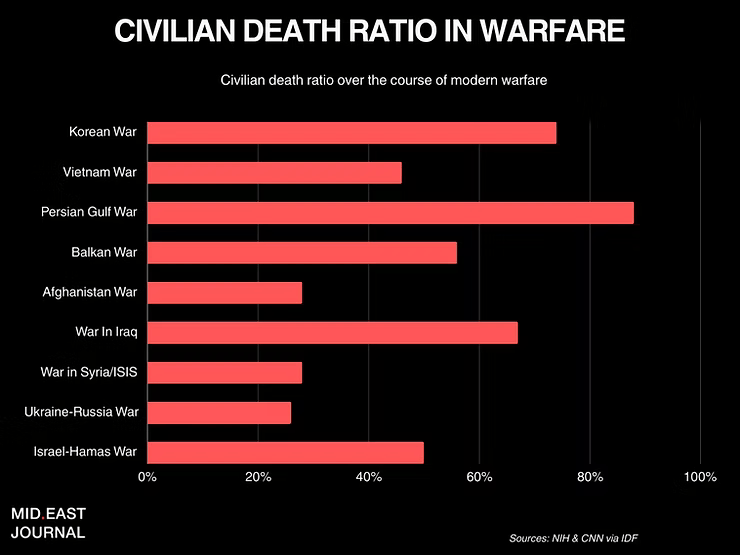
One final note; war isn’t significantly better at minimising civilian casualties. Not that we could ever compare properly, but for historical wars to be worse than this would probably need impossibly high civilian death ratios. It’s also worth mentioning that while this chart puts the civilian deaths in Gaza at around 50%, Israel’s own estimates would place it at 83% or higher. Source.
War is awful, and always has been. Being able to say we’ve overcome it is one of the greatest arguments proponents of Fauxgress could make. But we haven’t overcome it, we’ve refined it and made it as deadly as possible. One shudders to think of what war would be like today if we didn’t implement systems like the UN and aid organisations like the Red Cross. You could make the case we’ve done a great job lowering the ratio of people being exposed to war, but for all the people who are exposed to it war is as brutal as ever – if not more deadly than it used to be. I for one am not satisfied with this situation, where some of us get peace while others suffer immensely. This is Fauxgress at its finest – the rich in the West and other wealthy countries get to pretend war is of the past, while other parts of the world are bombed and blasted into oblivion. Don’t forget, four of the the world’s five biggest arms dealers are the permanent security council members, and Western technology and weapons are present on modern battlefields even if the soldiers aren’t. This system is repugnant, not a moral success. To genuinely see a just and prosperous world, we need to do better than this. We need to turn off the Death Machine, not just point it somewhere our cameras don’t usually film.
– The Teaspoon


Leave a Reply