How comfortable are you with uncertainty? Is it a friend you make welcome, or a hazard and headache you try to keep away from at all costs? Certainty makes for a more comfortable life, to be sure, but is it healthy for us to want and expect it as much as we do? I want to caution us, both you and me, from relying too much on certainty. Because while people are often very critical of faith and spirituality, and tend to presume that the more integrated into belief systems of faith someone is, the more exclusive or belligerent (like the classic religious ‘fundamentalist’), I’d argue it’s actually certainty and the lack of doubt that creates dangerous philosophies. It’s not the fundamentalist’s spiritual faith, but their complete confidence they know all the answers and truth that leads them to be dismissive or callous. And you don’t need to be religious to have that kind of callous certainty.
We often picture religions as being very hostile to doubt and question. That’s the whole principle of doctrine and dogma, right? You must believe this, or else. ‘Don’t ask us why, just do as your told.’ Perhaps you’ve had an encounter like that yourself; I wouldn’t judge you if it left you with a certain distaste for spirituality altogether. But counter-intuitively, all spirituality depends on a level of doubt and uncertainty: that’s what faith and trust emerge from, after all. If we had all knowledge and all answers, then there would be no faith involved in religion at all. Ultimately, faith rests upon a bedrock of questioning and doubt, a slightly uncomfortable position where easy answers are denied to us, and we’re made to exist in the disquiet. Doubt is the place where our ego is dislodged, and we’re forced to content with questions that might not have answers. Rather than being some monster to be defeated or silenced, doubt is a natural sibling to faith and a key part of any long-lived spirituality. Too often, religious institutions have attacked doubt as something to be expunged, fearful that a questioner might become a nonbeliever. But in practice, squashing our questions deep down does not resolve them: the toxic brew such inner conflict generates is far more harmful to a journey of faith than any difficult question or night of doubt.
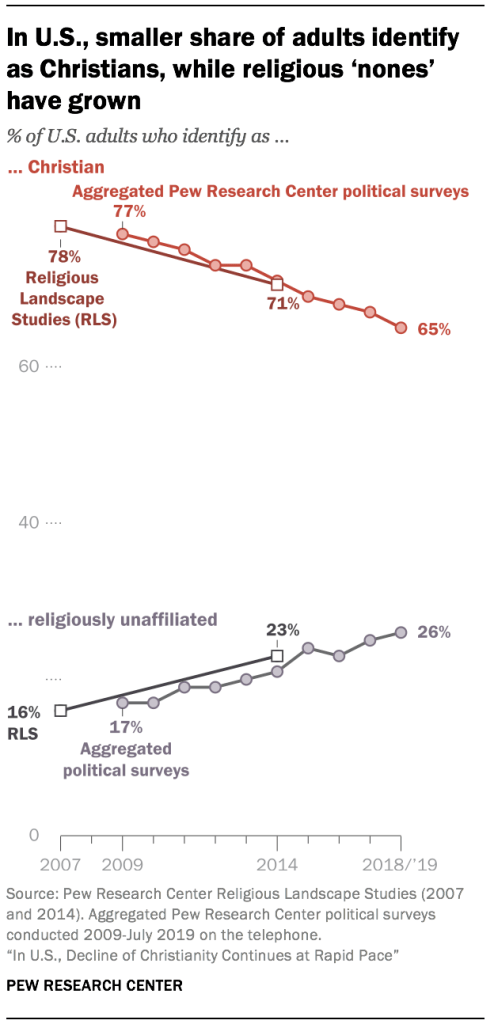
Letting more people doubt and question might be frightening for some in the church, but I think by
this point we can safely say the “Don’t ask, just believe” model hasn’t worked very well. Source.
Certainty though, is a bit different. Because when we know something to be correct, we render all other alternatives wrong and lesser. If we know exactly which people are the “saved” holy ones, we can assess everyone else to be profane heathens. If we know who is ordained for heaven, we also know who is excluded from it. These examples are from a religious context, but this problem isn’t confined to a church or temple. If we know the best society is a Western Democracy, then how can we possibly see First Nations peoples as our equals? If we know our way to understanding the world contains all truth, what space is leftover for anyone else? The absence of doubt and disquiet makes it much, much easier to build walls around ourselves and “our people,” enables us to dismiss that which is different. A person with complete certainty in all their opinions is, inter-personally, a giant pain to talk to – let alone argue with. An institution or country with complete certainty in its authority or truth is likely to start removing the ‘wrong type’ of people who can’t, or won’t, get with the program.
Over the years, I’ve seen people connect progressive politics with religion disdainfully – comparing reading groups with Bible Studies or faith in progressive beliefs with dogmatic faith in a church or God. What it reveals, I think, is an intellectual attitude that far prefers cynicism over ideals and convictions. Something both the lefty and the religious share is a hope for the world, and a presumed openness to others and what they might bring. Do either live up to their ideals? Not usually – but then, that’s half the point of an ideal in the first place, and it’s far better to have virtues and fail to meet them than to be someone without virtues at all. But there’s something neat, something certain, in a cynical world where we’re all predictably acting in our self-interest, where the purpose of politics is power and where change outside the norms given to us is always suspect. The status quo is certain there’s no better way for us to be, and nothing substantial we can do to make the world better other than buy into the very systems which oppress and divide. That alone should be reason for us to question the utility of certainty.
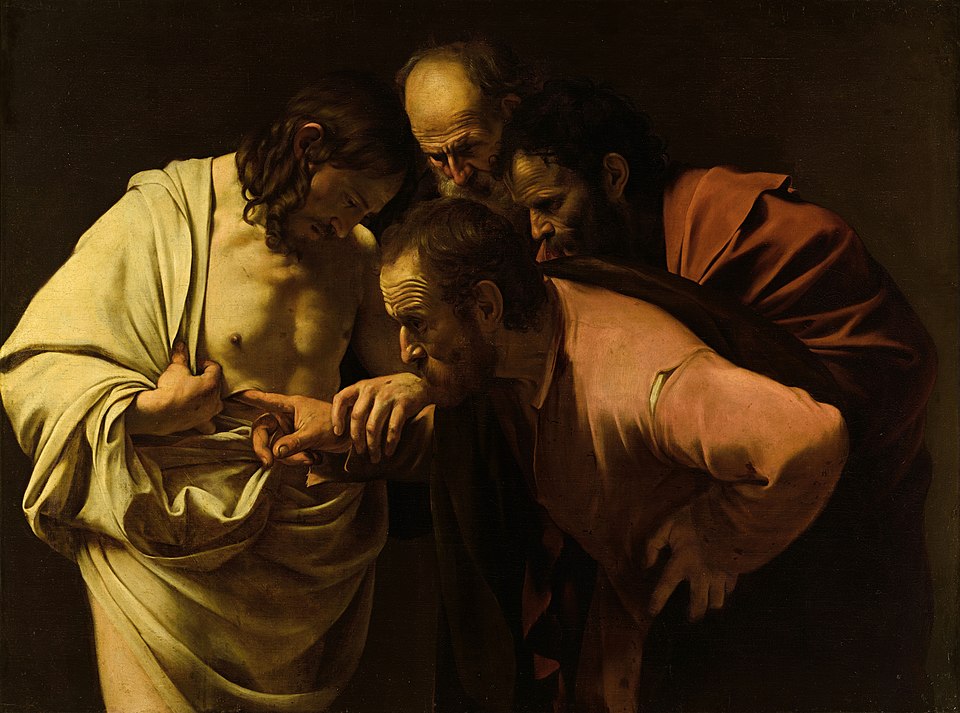
The fact that Thomas was skeptical of the story of Jesus’ resurrection, and his doubts didn’t lessen him among his peers, stresses that doubt isn’t something to be afraid of; it’s a natural part of the life of faith. Picture Source.
The funny thing about certainty and doubt is that the former is almost inevitably a bit atomising and self-directed. If I’m certain of something, I don’t need anyone else’s input or advice; actually, I don’t need anyone else at all. If we are certain of our worldview, if we believe we have all the answers already, then we can only provide assimilation and exclusion to all newcomers. But when I accept that I not only don’t know everything, but cannot know it, I’m forced to accept limitations. It’s in that place I understand the extent of my perspective, and the reality that other perspectives might perceive things I can’t. Not only that, doubt reminds us to be wary of closing doors on others. If we understand that despite our convictions and our confidence, we aren’t certain of everything, we hold open space for others to share and contribute. A measure of doubt is a necessity, alongside our convictions and beliefs.
So, a final question – how much space are you holding open in your convictions and beliefs? Is there enough doubt amongst your ideals and in your philosophy? Or are you too certain of what you know to be open to change, to the transformation that can happen when we realise how much more there is to us and our world than the things we’re certain of? Uncertainty tempers us and encourages us to look outward. Amidst the intersecting crises of our time, a lot of us could do with weaning ourselves off comfortable certainty, and let more questions, more wondering into our hearts. Who knows where, and to whom, it could take us?
– The Teaspoon


Leave a Reply