Warhammer 40k is getting trendy. Plenty of Fans have been coming to the hobby lately, just in time as the new 11th edition is coming out this week. Over the coming months and years, there’ll be new rules, updates to factions, and piles of new lore for everyone to dig their teeth into. In my own life, the presence and visibility of 40k has increased a lot in the last six to twelve months. Friends and acquaintances have either discovered 40k or come back after long absences, building and painting their little armies. Some are playing the games, or reading the books, or watching reviews from online creators. I’ve even collected some minis myself and been painting them – it’s always good to have hobbies away from screens these days. So in celebration of the coming new edition and in acknowledgement of a growing community, I’d like to take the time to reflect on what the setting of 40k gets right, and wrong, in its depiction of the fascistic, authoritarian Imperium of Man.
Before I go further though, it’s probably wise to give at least a small overview of the setting and specifically the Imperium. Set in the far future (roughly 40,000 years), Warhammer 40k is a bleak dystopian setting in which there is no hope or progress – only war. Humanity still exists and indeed is the largest power in the galaxy, but has become a bloated, tired empire, experiencing a steady decline and collapse driven by constant war, injustice, and brutality. Many alien factions are overtly hostile or outright genocidal, and humanity is genocidally xenophobic in turn. Humans worship The Emperor of Humanity, an immortal being who ten thousand years ago reunited humanity into one giant empire before being almost killed during a civil war – to maintain his power and life support, thousands are sacrificed daily. It’s a very grimdark setting, so much so that the word ‘grimdark’ is often traced back to 40k’s introductory text. The trailer for the 11th edition gives a good impression of what the setting is like. Notably, 40k was created first and foremost for tabletop wargaming, with all the books, games, and the like coming afterward as supports. In fact, one of the key reasons humanity is depicted as being so corrupt and susceptible to civil conflict is to justify why any given two factions might be attacking one another on a tabletop. Now with all that in mind, let’s peek into the machinery of this setting and talk about what it gets right and wrong. First off, what 40k gets right about fascists and authoritarians:
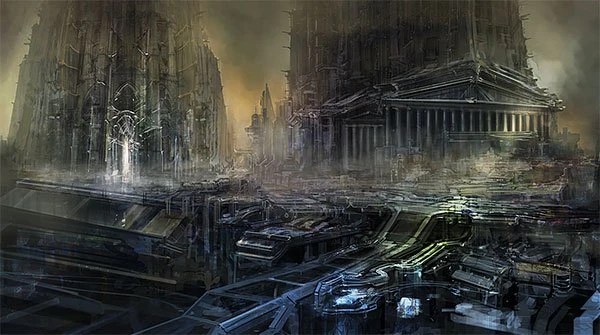
In addition to the literal horror of the Imperium, a nice thematic touch is that “Holy Terra,” the capital of the empire, is a polluted, irradiated hellscape of barren rock and gothic buildings; a place life can no longer exist naturally. Picture Source.
1. They’re Vile
It’s said that the Imperium of Man is the most vile and evil regime imaginable, and that’s as good a starting point as any. Some fans of the setting try to undercut how awful and cruel the imperium is, but the creators should be credited with given a clear-eyed depiction of how horrendous these kinds of regimes are, not just to their enemies but to their own. The Imperium shows no loyalty to its people (per the trailer: “you will not be missed”) and is happy to abandon billions to deaths just to save on ammunition. In fact, the Imperium will sacrifice millions of its own soldiers to save on time or money, or just to make a point. They might gesture at some greater good being served, but in reality, the elites of the Imperium are really just serving themselves.
Most of humanity live on highly polluted worlds, or perform hard labour to generate material for the constant, devouring war machine. There is no patience for weakness or resistance, nor any non-conformity. Not only is the Imperium horrendously racist and xenophobic in its attitude towards non-human life, it is also extremely dogmatic in cultural expression – worshipping or living wrong, of even just saying the wrong thing brands you a heretic and leads to summary execution. It’s a simple lesson, but one worth repeating anytime we wonder if throwing support behind the fascistic candidate could shake up the political status quo: these people, and the regimes they build, are despicable. They’re vile.
2. They’re Losers
This is, I think, one of the most important things to emphasis about fascists and authoritarians: they’re uncool losers. Now, there are parts of 40k’s lore and worldbuilding that are of course very cool: things like space, big guns that go pew, and dramatic story arcs. However, the Imperium isn’t just those things, and underneath its cruel and callous actions lie some truly embarrassing ideas. For one thing, the Imperium worships the Emperor by mistake: he actually didn’t want to be worshipped at all, and was very sceptical of religion, but in the devolution of his empire he’s essentially become a God. The warriors and leaders of the Imperium might wield mighty technology, but they don’t actually know how most of it works, and are so resistant to change or progress that it takes them millennia to adopt even basic reform. Space marines accidentally turned their instruction manual into a holy text – these people are pretty embarrassing.
The Imperium are also losers in a very literal sense: they keep losing. A key component of the setting is that humanity is on the verge of collapse from its internal decay and external threats: a constant state of extreme crisis. Its tempting to imagine fascist regimes like the Nazis as powerful, unstoppable warriors, but they aren’t. Every time these movements start to rise up, they’re either denied power from the outset, or in the cases where they do gain legitimacy, they eventually collapse in defeat and humiliation. As much as 40k depicts its characters fighting badass, incredible battles (something we will get to), its all for nothing in the end, in large part due to the next point on our little list:
3. They’re Incredibly Self-Destructive
The lore of 40k is vast and sprawling, but let me sum up one story. On the planet Vraks, a religious leader began to organise a military campaign for the glory of the Emperor. As this was outside his purview, the Imperial Inquisition sent an assassin to murder him. That attempt failed and the situation spiralled into a seventeen-year long war which killed millions of imperial forces and untold civilians, laid waste to an armoury world (a planet full of weapons and ammunition), and led to actual demonic incursions onto the planet – yes, 40k has demons in it, we’ll circle around to it. Not too long after the siege of Vraks, the enemies of humanity used space magic to shatter the empire in half.
In 40k, humanity is officially led by the Emperor, but in practice dozens of military and paramilitary organisations jostle for power and authority. The Space Marines, the Imperial Guard, the Church, the Inquisition, and many more are all vying to control what the Imperium does next, and regularly get so paranoid and protective of their power minor civil skirmishes and assassinations are constant. One of the major reasons fascists and the like tend to lose is they can’t help but target each other – holding the regime together is an impossible task. The Nazi leaders below Hitler were all in constant competition, fighting each other for access and power. The result? People who knew about attempts against Hitler’s life didn’t share it, hoping to use it as leverage down the track. Military forces didn’t cooperate. A war lost, a regime destroyed, and the deaths of all involved.
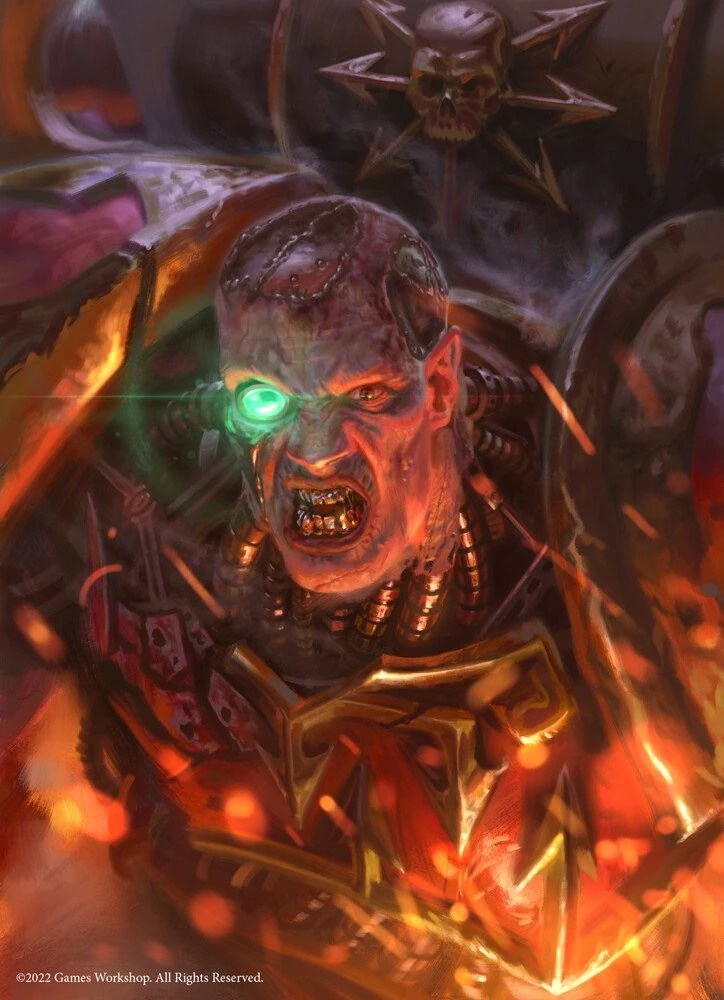
Lufgt Huron, a once-Loyal Space Marine turned corsair and thorn in the side of the empire; one of several notable enemies the Imperium created through its own failed policies and corruption. Initially, all Huron wanted was proper support to do his job. Picture Source.
I’ve been pretty glowing so far in talking about 40k, and to be fair the setting does a lot to imagine what a fascistic galactic empire would look like. However, there’s a couple things the setting gets really, really wrong:
4. They’re Cool
You saw what I said above about these regimes being full of losers, right? A side effect of making so many space marines and other Imperial figures so badass and impressive is you start to severely undermine that loser theme. Most of the time, the Imperium are fighting for the wrong reasons: wanting bloodshed, personal glory, or to purge non-human life. Even when the forces of the Imperium actually are fighting to help or protect the people of the Imperium (shoutout to the Salamanders), it’s all in service of this horrible, corrupt, and violent Empire which shouldn’t be preserved. If the Imperium defeated its enemies and won the war, would that really be a good thing? The people trying to make that happen should never come across as cool, but because humans are essentially the protagonists of the setting we keep getting these awesome, super cool guys covered in weapons and armour. Now, this isn’t a huge problem in depiction, but the next item on our list is.
5. They’re Right
Here we go. The big problem, the real problem with how 40k depicts the Imperium, is that they’re largely justified and correct in the views they hold and the things they do. Most people in the institution aren’t just bloodthirsty fiends, they do what they do to “protect” humanity. They abandon or destroy human worlds to conserve ammunition to protect other planets; they brutally target aliens to make sure humans are safe; they enforce complete obedience to keep the powers of their enemies at bay. Even the Empire itself, the project of the Immortal Emperor, was in-lore created because the Emperor realised that was the only way to prevent humanity’s extinction at the hands of powerful aliens. And this is the problem: he was pretty much right. I’ve not said much about the non-humans in 40k yet, so let me do that now.
The archenemies of humanity are the Chaos Powers, four God-like beings who corrupt and influence living things and seek domination over the universe. One of them creates deadly plagues; another seeks the most extreme (and often violent) sensation and pleasure possible; the third likes creating complex magical schemes in which humans are just pawns, and the fourth is the Blood God who sits on a mountain of skulls. It’s hard to take seriously the premise that the Imperium is the worst outcome imaginable for humanity, when Khorne the Blood God and Co. are just over there doing constant atrocities for fun. The Imperium justifies its genocidal racism by insisting that aliens just want to wipe out humanity, and that’s often true. While some, like the Tau and Eldar are usually reasonable, the Orks do war as sport and joyfully butcher billions, while the Necrons see humans as a lesser life-form to dominate or extinguish and the Tyranids would happily devour all organic life in the galaxy. Against the threats of Chaos, the Orks, or the Tyranids, can you really blame the Imperium for what it does?
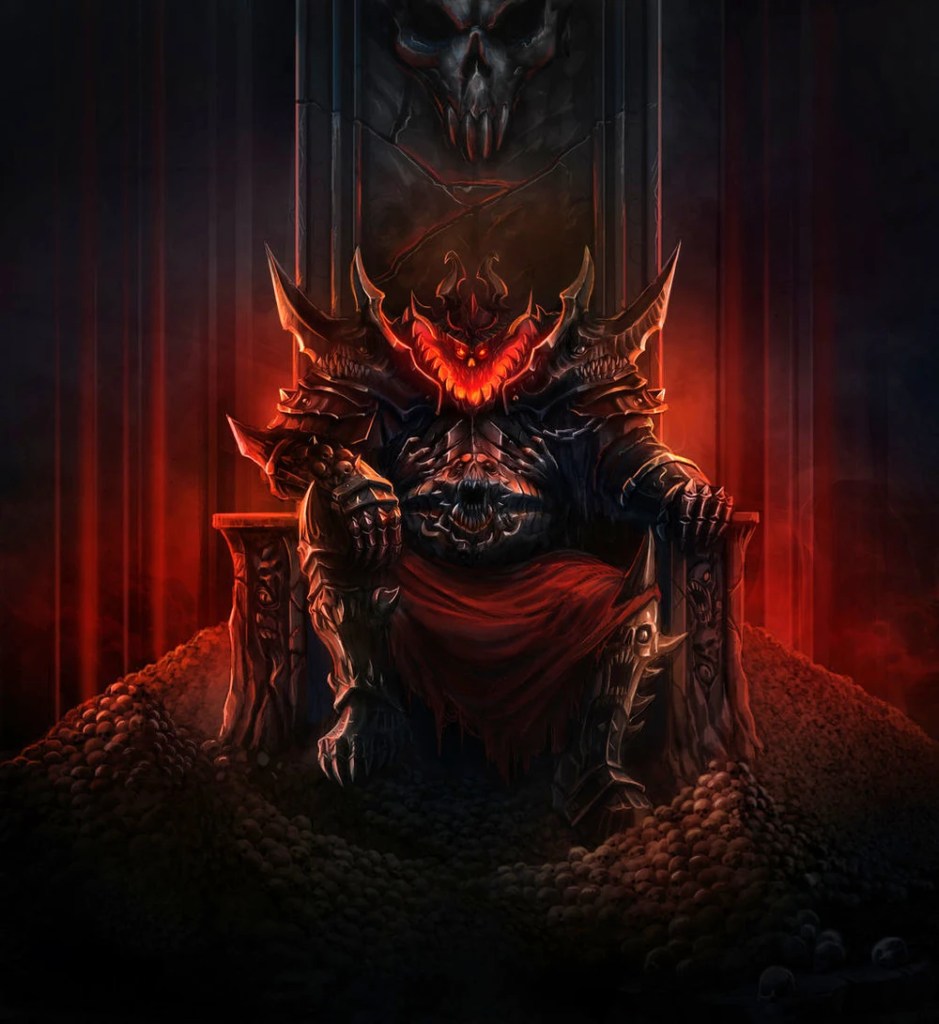
Oh, did you think I was joking about the skull mountain and Chaos God of bloody death? Did you presume I was being hyperbolic? No. Seriously, this is the face of principled opposition to the Imperium’s policy. Picture Source.
And that’s the problem. Remember, real world fascists don’t embrace genocide and violence for the fun of it; they insist that the nation, the people, are under threat and that brutal retaliation is a necessity for protection. It’s kind of hard to satirise that worldview while also presenting a setting where it’s regularly affirmed. Now, some writers for the setting have over the decades worked to counter this problem: every now and again, humans are able to coexist with aliens like the Tau without problem, and the Imperium’s xenophobia is clearly presented as wrong-headed. But that all sits alongside the wars against literal demons and omnicidal monsters, and it’s not inaccurate to say that without central authority and power, billions or trillions more might have died do these threats. This isn’t an anti-fascist depiction, it’s pro-fascist, and it’s not a surprise some very authoritarian fans have been around 40k. By comparison, in Helldivers 2, while all the enemies of Super Earth are brutal and cruel, their actions clearly depicted as retaliation for enslavement and genocide committed by Super Earth after the first game’s events, and it’s hinted regularly that if Super Earth ceased its campaigns of violence, the cycle could end. Helldivers has its own problems (including fans denying the lore to imagine a justified Super Earth), but at least it doesn’t accidentally validate the worldview of its fascistic empire.
I’m not going to tell anyone to not enjoy building and painting their little army men; I still enjoy my little collection, after all. But we shouldn’t lose sight of the problems with this setting, or uplift it as a “satire” without acknowledging the shaky ground that critique sits on. As 11th edition comes, enjoy responsibly.
– The Teaspoon


Leave a Reply