If you track Australian news, you might have seen the scandal that’s erupted around the Divine (formerly Unholy) Playhouse in Sydney. Operating out of the old Genesian theatre, itself an old deconsecrated Catholic Church, the Playhouse hosted queer art, theatre, and events. Or at least, that was the plan. But on opening night, the venue was protested by around 70 Christians who were outraged by what was going on, claiming the performances mocked the religious faith of Christians. Usually, protesting is a strategy that takes a long time to get results, but apparently not here – within days, the owners of the property had terminated the Playhouse’s lease based on an obscure 1842 law (that has never before been used in this context). Divine Playhouse announced a protest in response, which took place over the past weekend – the story isn’t over, but for now the “mockery” of Christianity is supposedly over.
So, what exactly is the “mockery” that has these Christians so angry? You’d be forgiven for thinking the anger was about the use of a church for the event – but in fact, the building isn’t a church and hasn’t been consecrated as one for almost a century. It’s been a theatre longer than it’s been a place of worship. In a world where old churches are turned into shops, offices, and airbnbs, you’d think one being used as a theatre wouldn’t be so offensive. After all, at least as an arts venue it’s still a place of community, and if the performances have religious themes or discourse than it’s the closest the building has been to a church in decades. No, the outraged Christians have insisted it’s not just about the venue – it’s about mockery of sincere Christian faith. It’s the “misuse” of ideas like holy water, choirs, communion, or the Holy Orders. But what right do the protesters have to control who can access these things? What entitles them to decide who is allowed to reach for Christian symbolism?
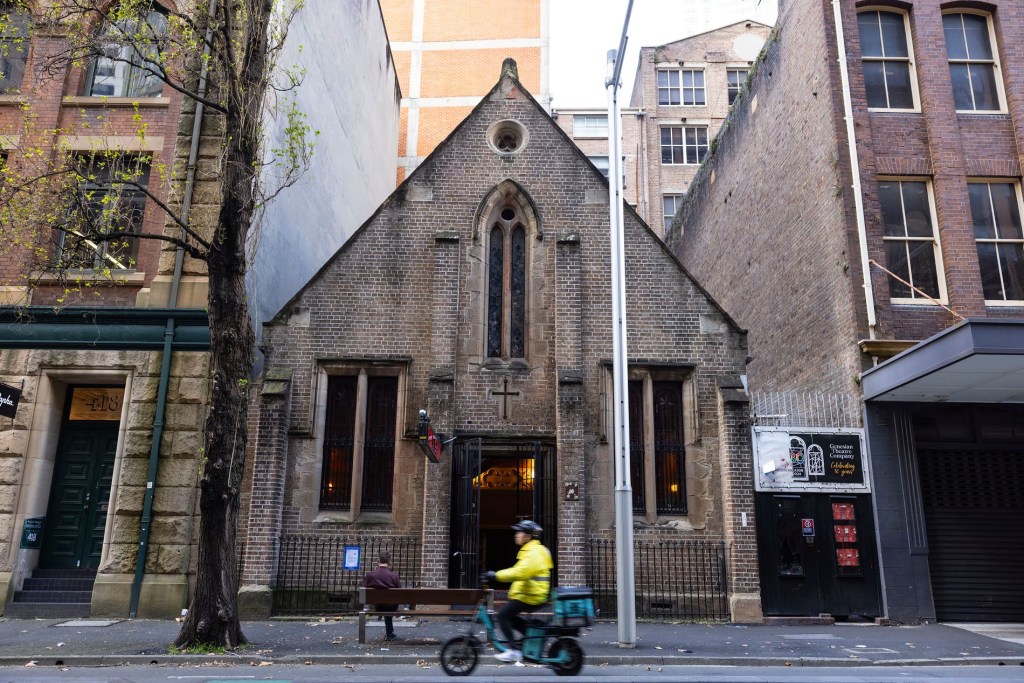
For the centre of controversy and mockery, the buliding itself is nice and unassuming. The cross in the brickwork would be a lovely touch if not for the fact protestors are claiming that’s a “misuse,” as though Divine could remove it. Picture Source.
Because many, many queer people grew up in the church and the faith. They spent Sundays in worship or children’s church, they received sacraments and read Scripture and prayed to God. And most of the time, they were driven away. It bears repeating: queer folk didn’t abandon the church, the church condemned them, refusing them either grace or mercy, sometimes even on their deathbeds. Organisations like the Sisters of Perpetual Indulgence formed in no small part to provide the pastoral care and love that the church should have given during the AIDS crisis, but refused to do. Time and time again, the community has stepped into the breach when the church failed to do its job. What right does any Christian have to deny these people their memories, their pain, their history? Even those who didn’t grow up in the church have still been wounded by it, still carry scars and trauma. They have every right to explore, to heal, and to reclaim that which has hurt them.
And again I have to ask, what exactly is a mockery of the faith? Is it mockery for people to earnestly express and explore pain, or to heal from it? Are people reckoning with their past or reconnecting memories of faith belittling Christianity? If so, how?
The funny thing about this “Christian” protest is that it wasn’t led by established leaders of the church. It wasn’t guided by bishops or by appointed denominational leaders, but two Hardline conservative Men’s groups: Fit for the Kingdom, and the Prodigal Sons. FFTK combines Christian conservatism with gym culture, using a barbell crossed by a sword as a logo – it almost looks like a crusader cross. Their focus seems to be instructing on how to be a “real man.” On social media, they have shorts of them “training for martyrdom,” which is odd since you don’t need to be strong to be martyred. They also reference the Roman Empire a lot, which is surprising considering that empire killed Jesus. Then we have the Prodigal Sons. These fine folk praise Donald Trump (red flag already, as far as theology goes), talk about preparing soldiers and warriors, and generally dislike minorities. Their leadership have connections to other fair-right movements in Australia, too. Unfortunately, their their social media presence only goes back to January 2026 and may already be removed from Instagram. If it isn’t already clear, then let me be direct: these groups are far-right activists, and don’t by any metric represent the church at large. This wasn’t a protest by “Christians,” it was one by anti-queer far-right men’s groups using Christianity as a shield from criticism, a veneer of faith to justify and enable attacking the vulnerable.
Who was making a mockery of the faith again?
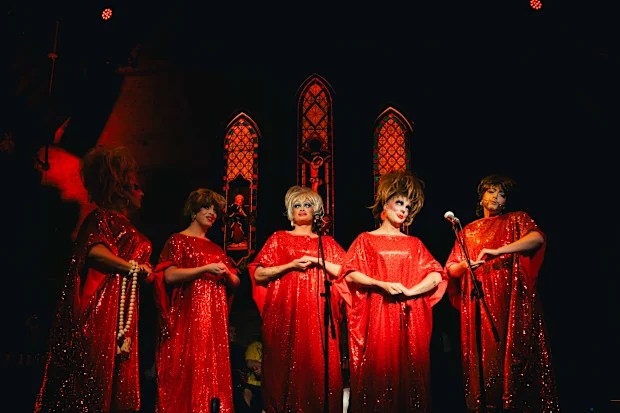
For men so fixated on martyrdom and crusade, these guys are pretty easily rattled. If this shocks them so much, imagine how badly they’d take actual marginalisation from forces of power. They’ve a lot to learn from on how to answer injury with grace, ironically from the very people they hurt. Picture Source.
And the gross, horrible thing is, it worked. Their pressure on the landlords has shut Divine Playhouse down. These groups, who’ve more in common with the Manosphere than with Jesus’ teachings, have disguised themselves as mere offended Christians, trusting that parts of the church will instinctively take their side in discourse if they can shift conversation away from what these groups actually believe and into a space where the faith appears ‘under threat.’ An attack on queer people has been veiled as a moral outrage to inappropriate treatment of faith. But Jesus never stood for violence or for condemnation. When a woman was caught in adultery, he refused to judge her. When he walked the earth, he joined in the parties with indecent people and sinners – it’s something his opponents challenged him on repeatedly. The Prodigal Sons say Christianity isn’t a “soft” religion, but they’re simply wrong. The faith has always been about love, forgiveness, mercy, generosity, and gentleness. If Aunty Jonny Hawkins is right, and the queer community are better at demonstrating the qualities of Jesus than the church is today, that doesn’t mean anyone is “mocking” the faith. It means the church isn’t following its call.
I don’t claim to have authority over the faith: I can’t declare who is and isn’t acceptable to God. But Scripture says we know a tree by its fruit, and the fruit of God’s spirit is love, joy, peace, patience, kindness, goodness, faithfulness, gentleness, and self-control. When I look at groups glorifying violence, generating outrage over a marginalised group sharing community together, cheering for them to be bullied and shut down, it’s hard for me to spot the Spirit’s fruit. I can’t help but question what the point of this outrage even is, if there’s even a point at all. It’s just anger for its own sake, or to raise the profile of conservative groups hoping to gain a platform. Divine Playhouse being shut down isn’t a victory, it’s a tragedy and a farce.
If you’re interested in supporting Divine Playhouse right now, there is a petition and a gofundme.
– The Teaspoon


Leave a Reply