I sometimes think about Ursula K Le Guin’s The Ones Who Walk Away from Omelas. It’s a short story, telling the tale of a utopian City of Happiness, a land of peace, plenty, and delight. The reader is encouraged to imagine Omelas in their own eyes – perhaps yours is a fairytale kingdom, or maybe it is technological and futuristic. In either case, Omelas is the most wonderful place to live, one where everyone is able to exist in comfort, with safety and prosperity guaranteed. Well, almost everyone. The great secret of the city is revealed to young Omelans, once they’re old enough. In a small closet in a basement, there is a child living in filth and utter isolation. The terms of the bargain made to bring about the joy and prosperity and wonder of Omelas is that this one child must be kept in misery. The child cannot even hear a kind word. Those are the terms of Omelas.
Would you accept these terms? It’s something of a moral philosophy question, and yes, there is at least one star trek episode exploring it. Omelas is a paradise, but not one borne out of naiveite or simplicity: the people aren’t the “pure” ones before mankind’s fall. They are just as wisened, ‘civilised,’ and ‘developed’ as we are. And they know the child is there. Some even go back to see the child again, but most are content just knowing. While they were sickened and shocked as youths when first told, they come to understand it. How much joy could this child have if it even was let go? Could it really enjoy freedom after such captivity? And if were freed, the “beauty and delight” of Omelas would be destroyed – indeed, it would be throwing away “the happiness of thousands for the chance of happiness of one.” Would you accept the terms of Omelas?
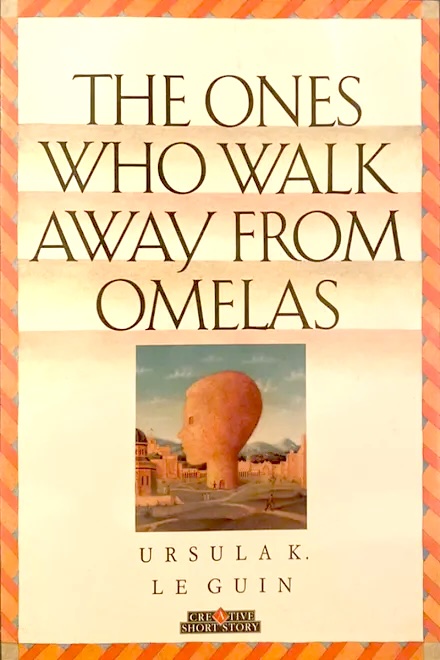
The downside of philosophy questions like these is we can get lost in the details, and miss the larger point being made. How exactly the child survives/is replaced is perhaps less important than what is says about us if we accept it. Source.
Truthfully, I think many of us already do. We in the West aren’t quite like Omelas; we haven’t distilled inequality down to a single child (yet). But we live in a world of comfort and delight, one just as fantastical as the City of Happiness. Our towers touch the skies, our markets burst with produce, and we whizz around in cars, trains, and aircraft. We can purchase almost anything we desire, and thanks to technology we have almost all of human knowledge at our fingertips. Even now, brilliant minds are trying to undo aging to extend our lifespans, exploring the reaches of outer space, or developing robots which can end labour and work as we know it. Incredible, isn’t it? And that’s the pitch of our modern world – this is the Golden Age, the pinnacle of civilisation, a world where so many are lifted from poverty and pain into delight and wonder. The arc of history has bent towards justice and plenty. Look at everything we’ve accomplished.
But what are the terms of our bargain? What is our prosperity and plenty built atop of?
In The Ones Who Walk Away, all the filth and isolation and pain is concentrated onto one child. On earth today, things are little more dispersed, but don’t think that changes the stakes. Dazzling cities like Dubai are built by dispossessed and underpaid workers, trapped in the country and forced into deadly labour. Our cars and aircraft poison the planet, causing environmental damage somewhere else as the climate changes. Produce and products are concentrated in wealthy (mostly Western) countries, while the rubbish and garbage we reject is shipped offshore to be dumped elsewhere. Our AI tools were built through theft, and underpaid workers sift through the violence and the explicit to make sure the model works properly when you ask it for cooking advice. Our ‘Golden Age’ stands on the misery of millions, who work and suffer and die to make sure we are fed, happy, and comfortable. Wealthy nations take it for granted that they have a right to intervene and invade to protect their ‘interests’ – it’s a shame the people being invaded or dispossessed don’t have those same rights.
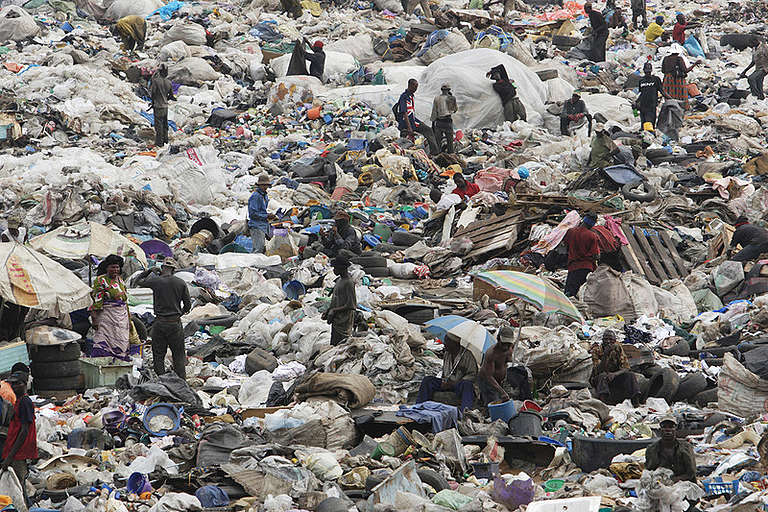
The cost to having more than we could ever use/consume is that all the rubbish goes somewhere – and it’s telling whose problem things like waste or pollution become. Source.
These are the terms of Omelas. I’ve mentioned before my scepticism that we have actually done much to reduce poverty, hunger, or violence, but in truth even if we had reduced itI don’t know if it would matter. Is it worth most of us being happy and content if that happiness is because we locked up the others in a closet and their own filth? Is that a system we should even desire? Are you satisfied knowing most of us are happy when that happiness is dependent on the misery of someone else? Le Guin ponders whether it would be acceptable for a society to be built on the misery of a single child. Well, ours is built on top of the suffering of millions. And like Omelas, we can’t change the terms of the deal. If the people who made our clothes and grew our food were paid properly, things wouldn’t be so cheap. If we put our ecology first and prioritised sustainability, we wouldn’t have all this tech, certainly not this fast. If we worked to make sure every child had food and shelter, that nobody was trapped in the dark alone, we wouldn’t have all this private equity. If all the people of the world all had as much say in their political wellbeing and autonomy as the West does, then our prosperity would collapse.
Most who see the child come to accept it, find ways to rationalise and justify the misery. The child wouldn’t even enjoy freedom; it’s enabled to much joy and prosperity; the child is probably too enfeebled by its suffering to do or be much anyway. But not all the youth do. Some do not cry or rage, do not come to accept the ‘justice’ that their world is built on. They leave. Alone each walks out of the splendid City of Happiness, heading into the mountains. Sometimes an adult will leave too, falling quiet for a few days before suddenly departing. The ones who Walk Away do not come back. Le Guin admits she cannot describe place these are going to at all: it might not even exist. “But they seem to know where they are going, the ones who walk away from Omelas.” Is it good enough to have a world where most of us are happy and safe? Would it be enough if everyone but a single child were happy, if the cost to our happiness was to enforce misery? Maybe there was a time I could accept that, but I don’t think I can anymore. We shouldn’t have a world where we built comfort on exploitation, freedom on violence. I can’t stay in Omelas.
Of course, we cannot literally remove ourselves from the world we live in, but we can Walk Away internally. To stop believing in the myth that this is necessary, that the misery and inequality our world is built on is something we must come to accept. We can leave that behind and go out to find something better. Each person who leaves Omelas does so alone, but I’d like to believe as we each wander in that wilderness, crossing those mountains, that we can find one another. After all, it was our compassion and connection to each other that guided us to this place. I don’t know what kind of place we will find together, but I am confident that this is how we reach a better future. I know many of us ultimately come to accept the terms, find some way to justify and accept the brutal reality sitting in some basement just out of sight, since it enables so much that we love and need. But I hope that even if you aren’t ready to walk away yet, someday I’ll see you out on the road or the wilderness beyond. Because we can do better than Omelas. We have to.
– The Teaspoon


Leave a Reply